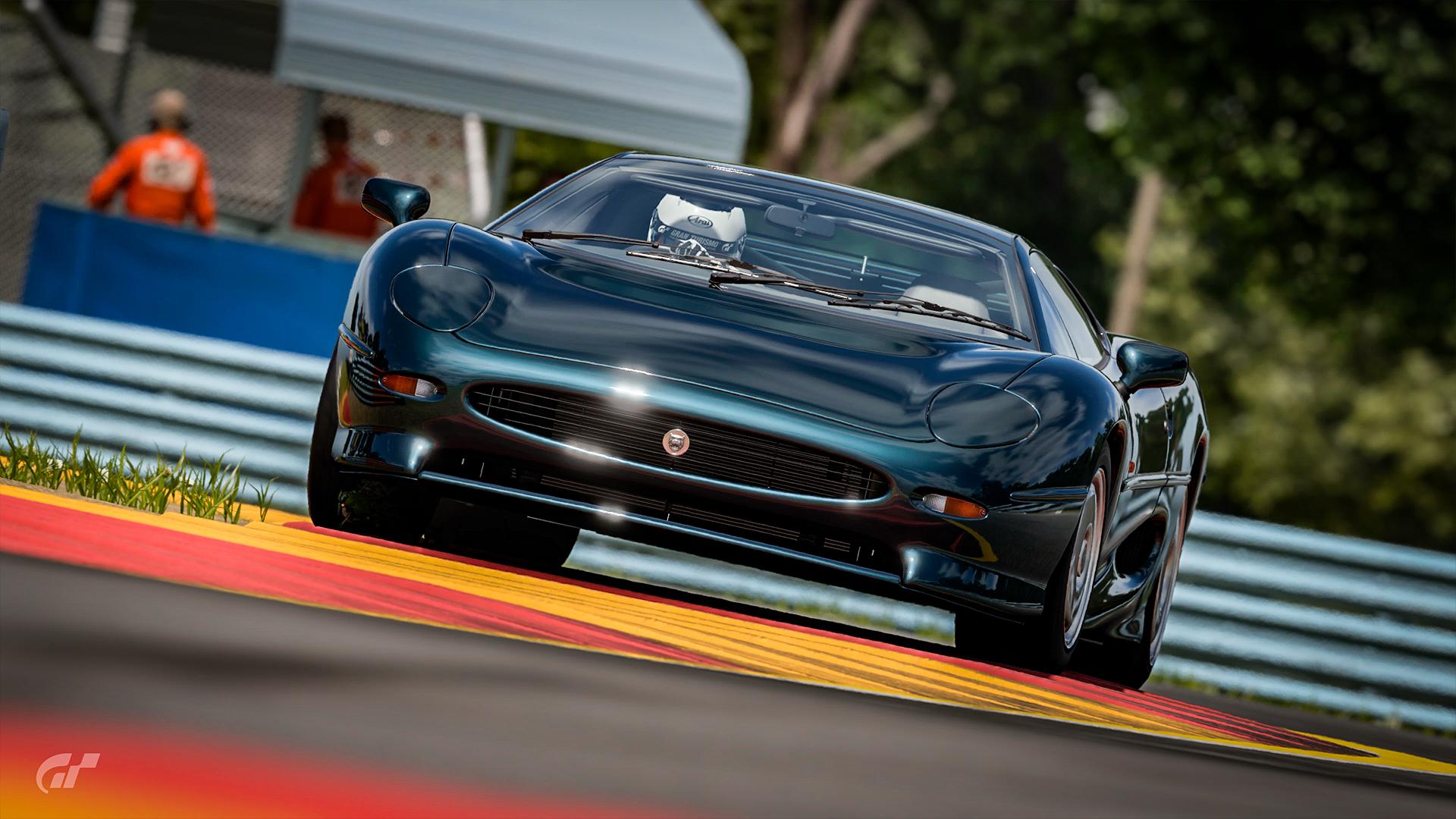
After driving another legendary nineties supercar a couple of weeks ago in the form of the Ferrari F40, this week’s Gran Turismo 7Daily Races give us the chance to drive another: the Jaguar XJ220.
Upon its release in 1992, the Jaguar was the fastest production car in the world, but how will it handle high-speed direction changes around Watkins Glen’s Short Course in Race A?
We settle into a familiar routine for Races B and C, with respective Gr.3 and Gr.4 events. However, this week, players are allowed to tune their cars, as both races allow minor brake balance alterations. Race B also offers players a rare chance to tune select suspension settings.
You can find GT7’s Daily Races in the game’s Sport Mode; offering online ranked racing with players of a similar skill level based on previous performances.
Race A
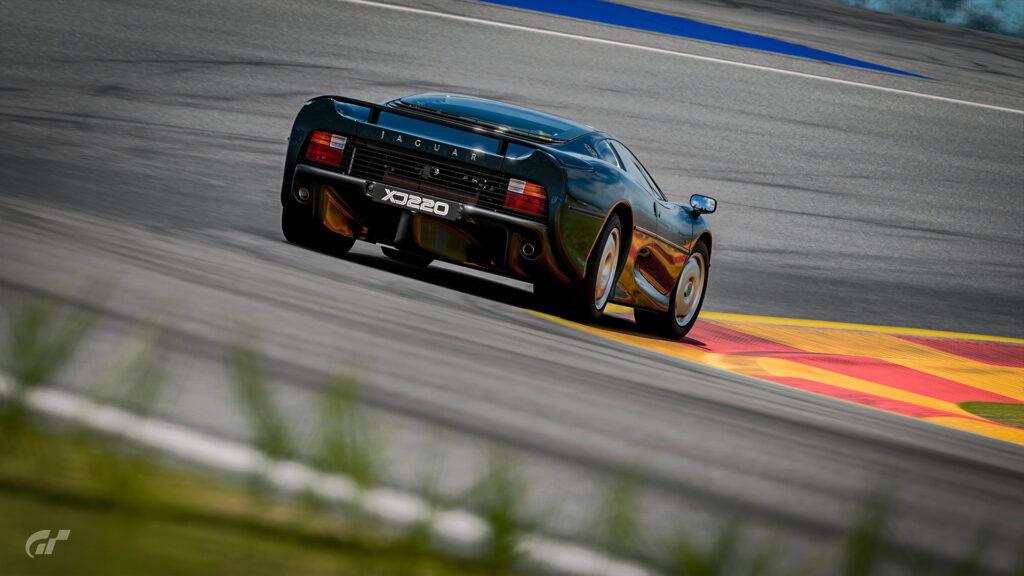
With a top speed of 212mph in 1992, the Jaguar XJ220 was the fastest production car on the planet. After this initial top speed attempt, the exhaust silencers were removed and the rev limit was raised, allowing its test driver – and the world’s most famous celebrity-botherer – Martin Brundle to achieve 217mph… even as the bonnet attempted to part ways with the car.
The record stood until 1994 when the McLaren F1 achieved a whopping 240mph, but the XJ220’s distinctively curvy silhouette and rarity help it stand out as one of the decade’s most revered supercars. (With its own officially-licenced game and an amazing soundtrack!)
However, it’s a bit of an ungainly beast, seeing as it was nearly five metres long, with its tiny wheels (by today’s standards) giving it a ‘sofa on casters’ look. Its engine was a sweet, sweet V6 from the Metro 6R4 Group B rally car, giving it plenty of motorsport pedigree while also shortening its gargantuan proportions (Jaguar originally wanted a V12 shoehorned into the XJ220’s chassis).
With lots of real estate, Watkins Glen’s Short Course is a great place to wring the Jag’s neck, just make sure to use all the kerbing you can – especially through the ‘Inner Loop’. Don’t be shy about spamming downshifts either – you don’t need to pay for the engine rebuild!
We’re off to Suzuka for Race B, with a straight-up Gr.3 sprint race on the cards.
For track advice, I suggest taking a look at one of our most recent GT7 Lap Time Challenge articles, where players had to pilot a Gr.2 Honda NSX Super GT car. Gr.3s aren’t as quick, but most of our track guide is still applicable.
Normally, Gr.3 and Gr.4 cars have fixed set-ups to keep races balanced, but suspension and brake bias settings can be changed on your chosen car this week.
However, players have to make do with tweaking damper bump (compression) and rebound (expansion) settings only, and, in our experience, softening these (decreasing) provides extra grip and assurance in corners.
For extra tips on suspension tuning, check out our GT7 set-up guide. It focuses on front-wheel-drive road cars but much of the principles still apply to thoroughbred racing machines.
Race C again allows players to alter their brake bias settings, so experiment with what feels best for you (we recommend going one or two clicks rearwards to aid turn-in).
The race takes place at the notoriously tricky Autopolis International Raceway, with the Mercedes SLS AMG Gr.4 proving to be a capable car.
While tyre wear is set to normal levels, fuel consumption is seven times the standard rate, making Race C a lift and coast challenge for the thirstiest cars. Players should also note that hard compound tyres are required to be run at some point during the race, so it might be quicker to use mediums and switch to hards for one lap.















Discussion