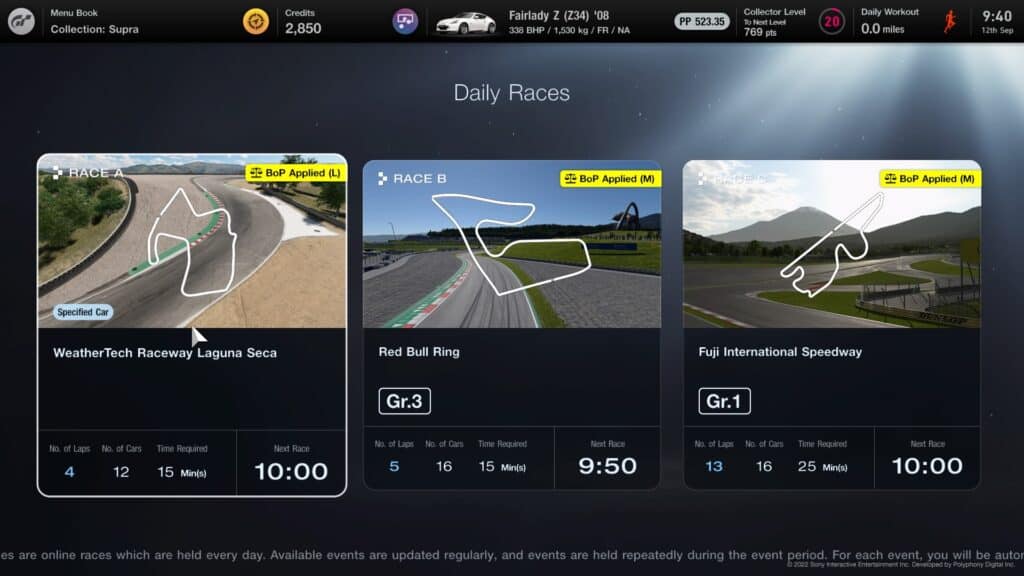
We visit three historic venues in three different continents in Gran Turismo 7‘sDaily Races this week, with Laguna Seca, Red Bull Ring and Fuji International Speedway on the agenda.
Disappointingly, all races this week feature 1x Tyre Wear and Fuel Consumption, which takes away the element of strategy from proceedings. Although if you prefer uncomplicated sprint racing, this is the week for you.
As ever, Balance of Performance (BoP) is crucial, but the troublesome Gr.4 cars have been benched this time round in favour of the ridiculously fast Gr.1 cars. This doesn’t mean to say that there’s not been another BoP disaster, however…
As a reminder, we are now using GT7‘s new Balance of Performance (BoP) system, introduced in the v1.19 July update. BoP is now split into three categories depending on the type of track used: High-speed (H), Mid-speed (M) and Low-speed (L).
As of the 30th of May, Race A’s performance should not affect players’ Driver Rating (DR) and Sportsmanship Rating (SR). However, in a break from the norm, all of today’s races will count towards GT7 players’ DR and SR. A little circumspection and practice will be required before competing then!
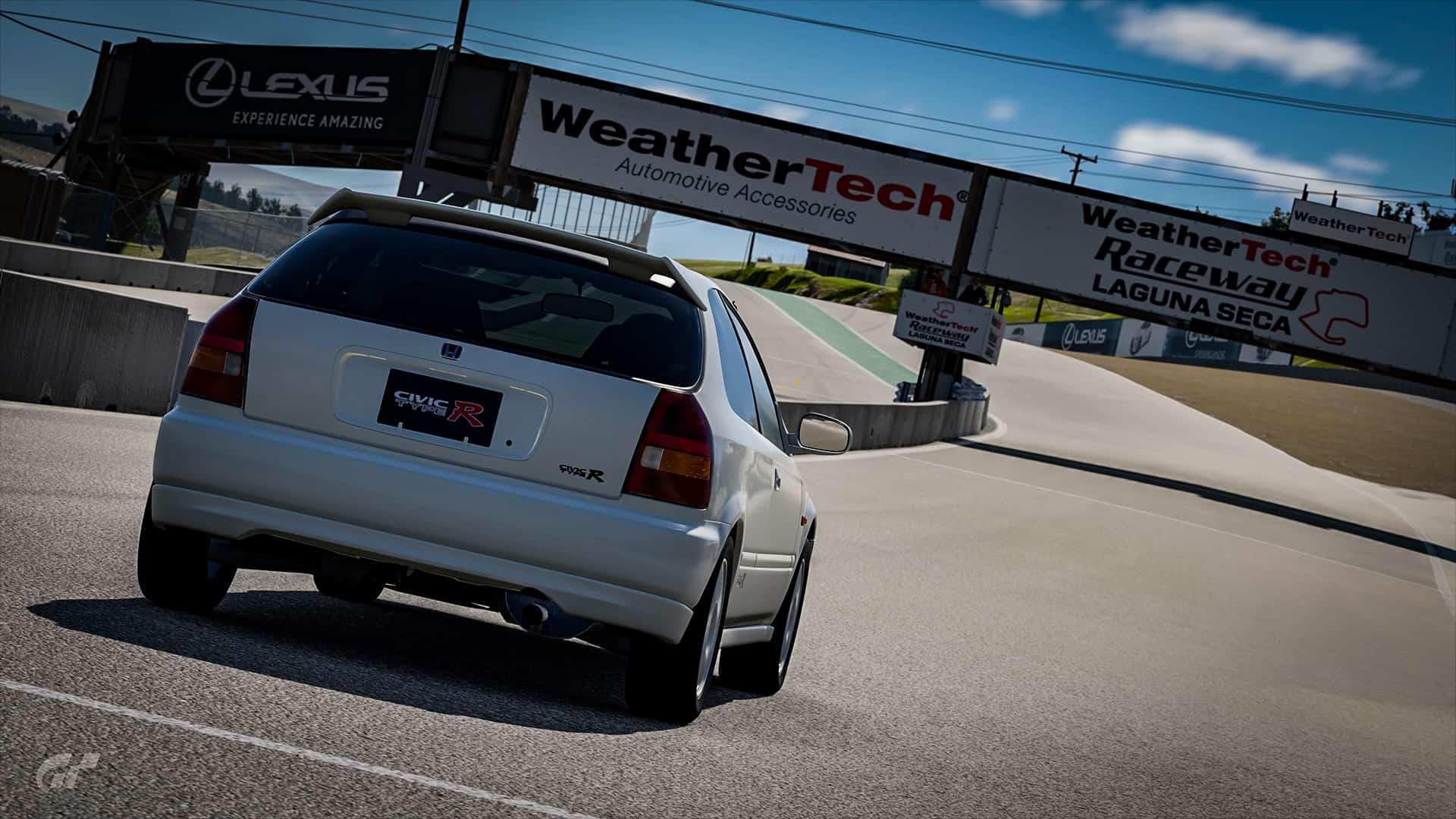
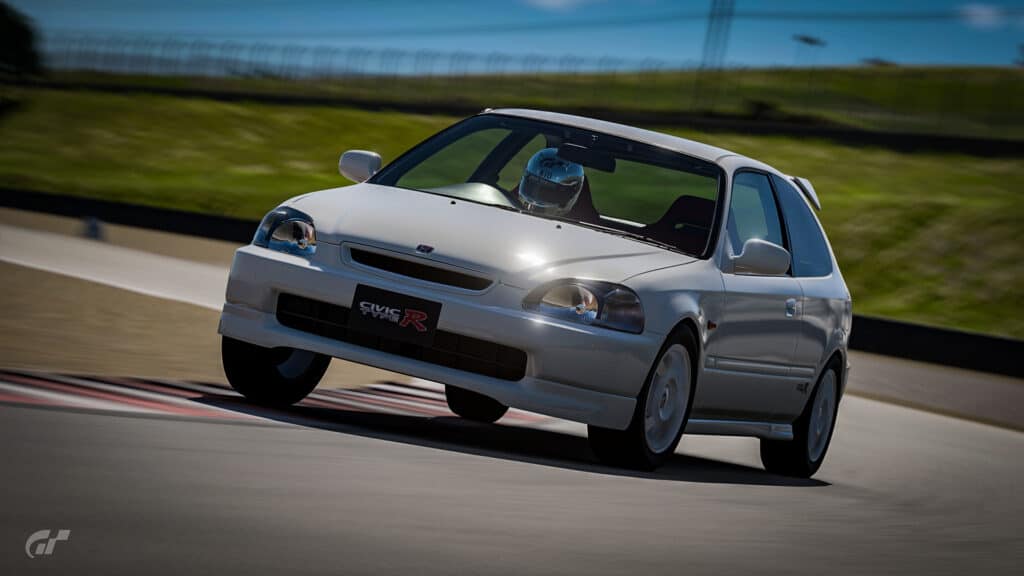
The trusty little 1997 Honda Civic Type R was the car of choice for boy racers in the late ’90s, and its VTEC engine was as much fun to rev as the Civic was to handbrake turn – as could be witnessed in any supermarket car park.
The EK9 shape model was the first Civic to undergo the Type R treatment, and featured a re-tuned engine and chassis, with bigger brakes and extra body stiffening to increase the sportiness of the driving experience. Laguna Seca is a huge technical challenge to drive, but its dips and crests are ideal territory for a small Japanese hatchback. The track has been used throughout the decades in Can-Am, the American Le Mans Series and CART.
Just last night, (11th September) Spaniard Álex Palou took victory in the final IndyCar race of 2022. In the back of his car was a Honda Engine. Probably not the same one as the Type R, mind.
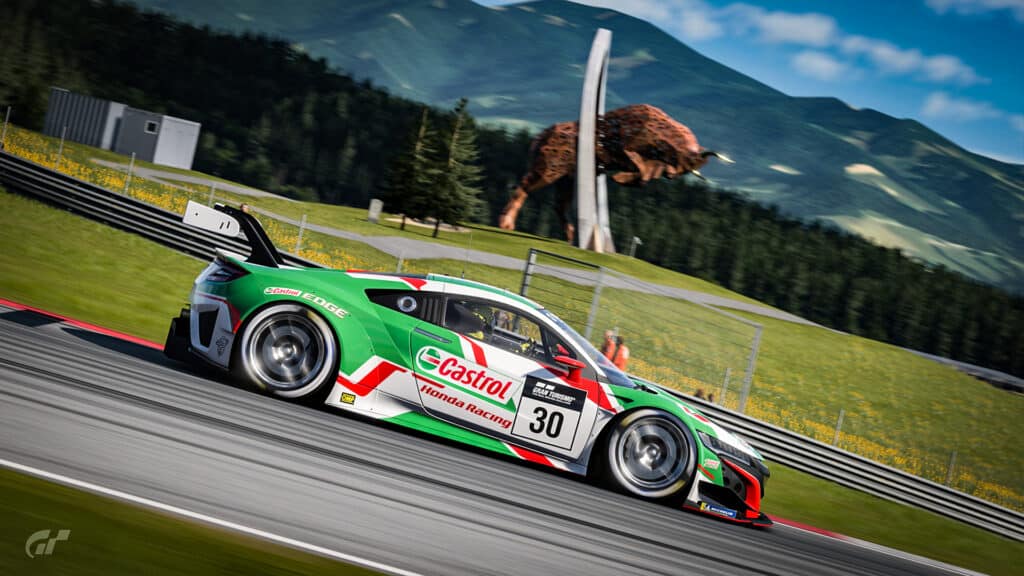
The Honda theme continues for Race B, as the manufacturer’s baby supercar – the NSX – is the weapon of choice for Red Bull Ring’s straights and hairpins.
Notable for being a hybrid, the NSX was released in 2016 as a successor to the first generation of Honda’s epic driver’s car. Although it wasn’t quite as engaging to drive, the car’s 3.5l twin-turbo V6 could propel it to 62mph in less than three seconds, thanks to its four-wheel-drive system and 573bhp.
Red Bull Ring has undergone several transformations in its lifetime, starting life as the high-speed and dangerous Österreichring, before being shortened and upgraded into the A1-Ring ahead of its final destination under Red Bull ownership.
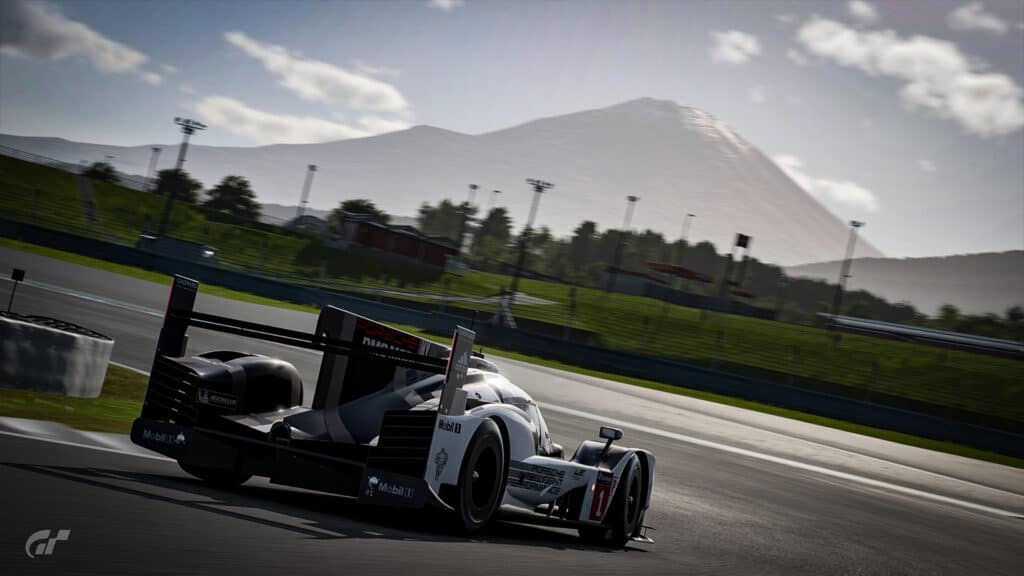
It’s a bit of a BoP disappointment in Race C, as one car stands out as an overwhelming favourite among the Gr.1 contenders: Porsche 919 Hybrid ‘16.
Built to dominate the FIA World Endurance Championship (WEC) and 24 Hours of Le Mans (which it did), the Porsche is a product of the LMP1 Hybrid regulations. Featuring a 2l four-cylinder engine coupled to a lithium-ion battery, the car produced a combined 900bhp output.
Added to its mass of just under a ton, the car was quick. Very quick.
It’s quite apt we’re racing at Fuji in Race C too, as the venue’s 2022 WEC race took place over the weekend (11th September), with Toyota taking a one-two result.
With Porsche returning to the top class of prototype racing in 2023 with its LMDh contender, it surely won’t be long before we see the Weissach manufacturer’s name back at the top of the timesheets. Race C uses the Mid-speed (M) BoP format.


Discussion