Simagic Zeus Series review: Bang for buck is worth the extra work
Simagic's Zeus Series introduces three new steering wheels with the option of the modular MagicDash 4 DDU and a proprietary wireless AirLink connection system. But is it too clever for its own good?
Simagic’s latest Zeus Series product line once again appears to offer tremendous bang for buck.
Featuring three distinct steering wheels: the Formula, Sport and GT, the arrival of the Zeus Series coincides with the release of the firm’s long-awaited MagicDash 4 digital display unit, with two options on how to connect this to your PC (MagLink Pro or AirLink).
In addition, there are multiple wheel rim options for the GT and Sport steering wheels, as well as several differently priced bundles to consider. And that’s not to mention the various add-on paddle kits available.
If this all sounds confusing, that’s because it is.
However, I’ve tested all the new products over the last few weeks to try and unpick what the Zeus Series offers sim racers and whether it feels like Simagic has created a cohesive ecosystem.
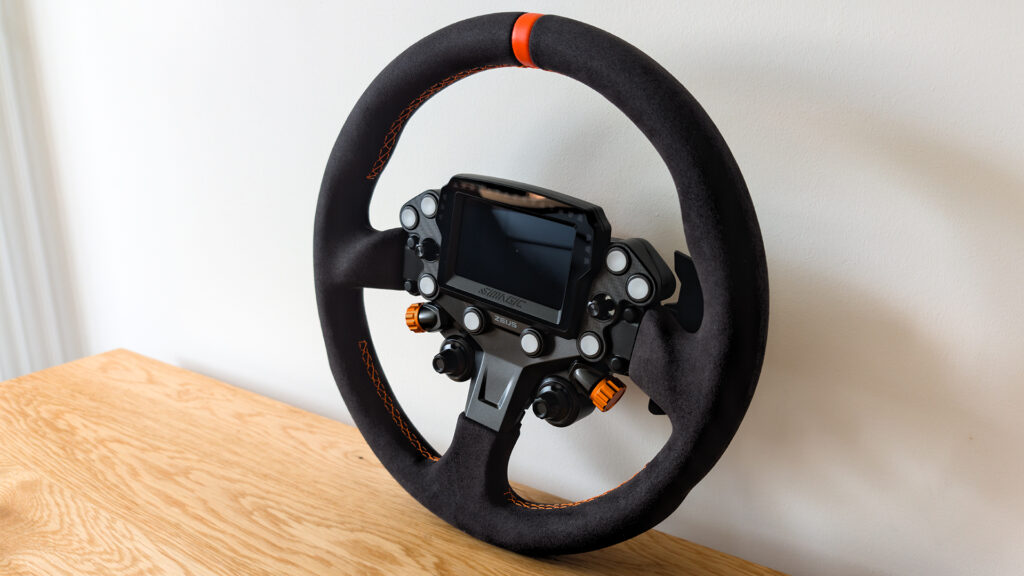
Zeus GT
Ergonomics
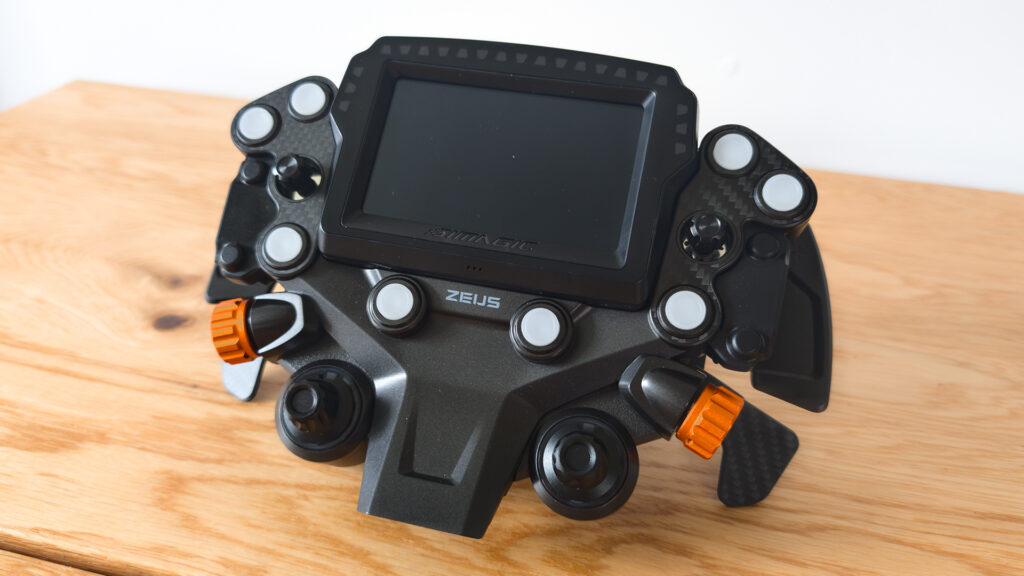
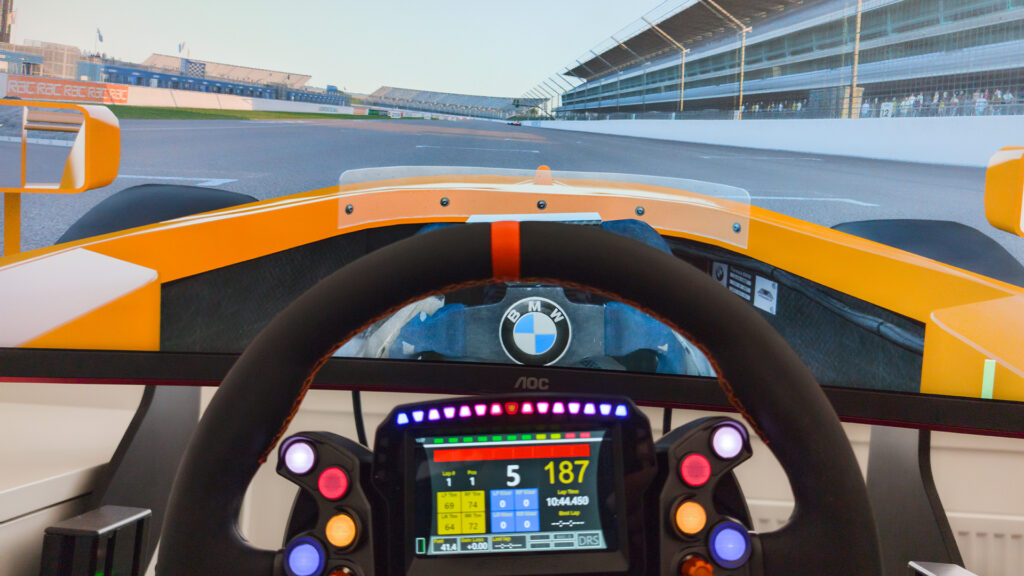
Each Zeus wheel can be purchased with or without the Magic Dash 4 (AirLink and MagiLink Pro connectors are included with the latter, depending on your setup), but if you opt not to buy the DDU, your wheel will look very bare indeed. Make no mistake, the Zeus steering wheels look their best when the MagicDash is fitted.
In terms of weight, the Formula is 1.63 kg, including the MagicDash 4; the GT 1.41 kg; and the Sport 1.56 Kg. However, with all three, the mass of the optional DDU makes the wheel feel top-heavy and unbalanced while in operation.
It’s not a deal-breaker by any stretch, as comparable steering wheels I’ve tested feel much less centred, but it’s the first hint that the Zeus line has to cut some corners to offer such impressive specs at a relatively affordable price (more on this later).
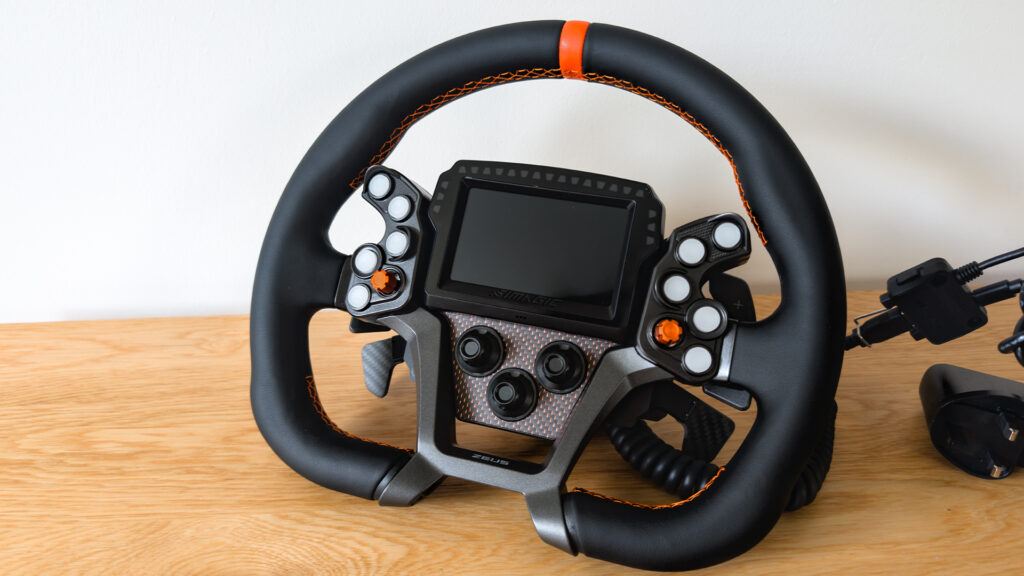
The Zeus GT fitted with the MagLink Pro connector
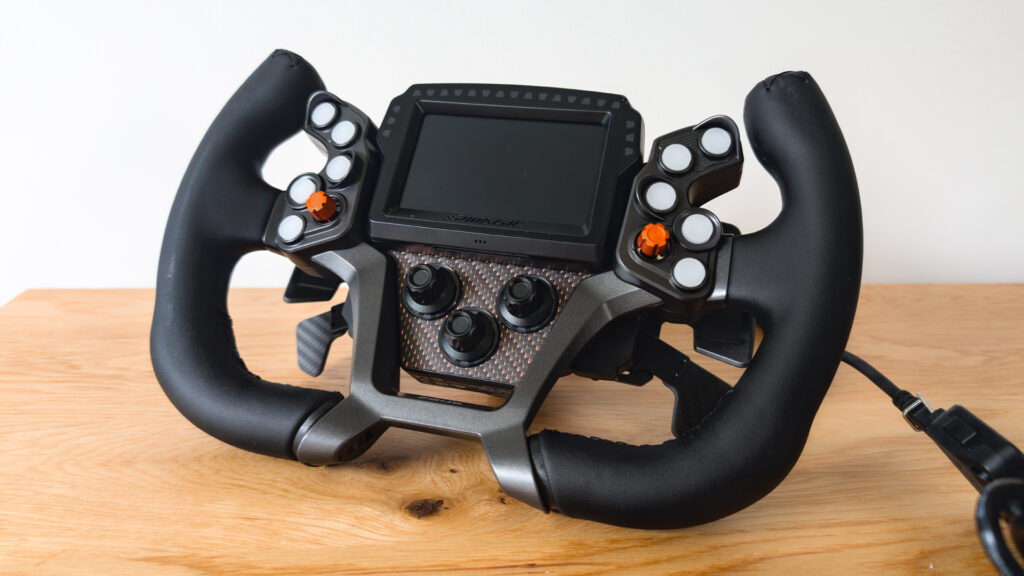
Formula
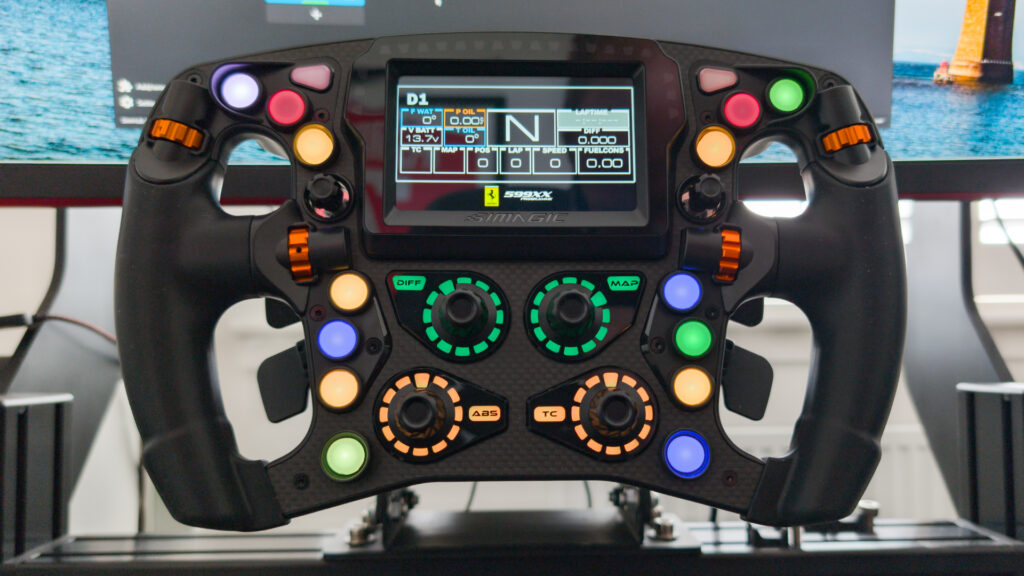
The Formula is likely to be the most popular option and, at 280mm wide, is suitable for both modern GT and single-seater cars. Arguably, it’s the most attractive of the three, with a wider carbon fibre faceplate, but the silicone grips are less than premium feeling in my opinion.
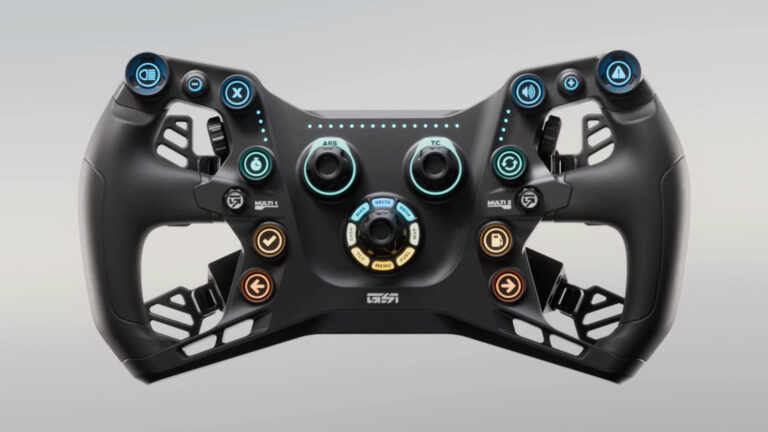
Spec-wise, each wheel is adorned with a plethora of buttons, paddles, switches, and rotaries (the Formula has the most utility in this respect, with up to 92 configurable inputs), plenty to cover all required inputs for iRacing and Le Mans Ultimate.
Each wheel also offers two sets of paddles, with the option to upgrade with a range of add-on options (including a set of push-pull rally-style paddles).
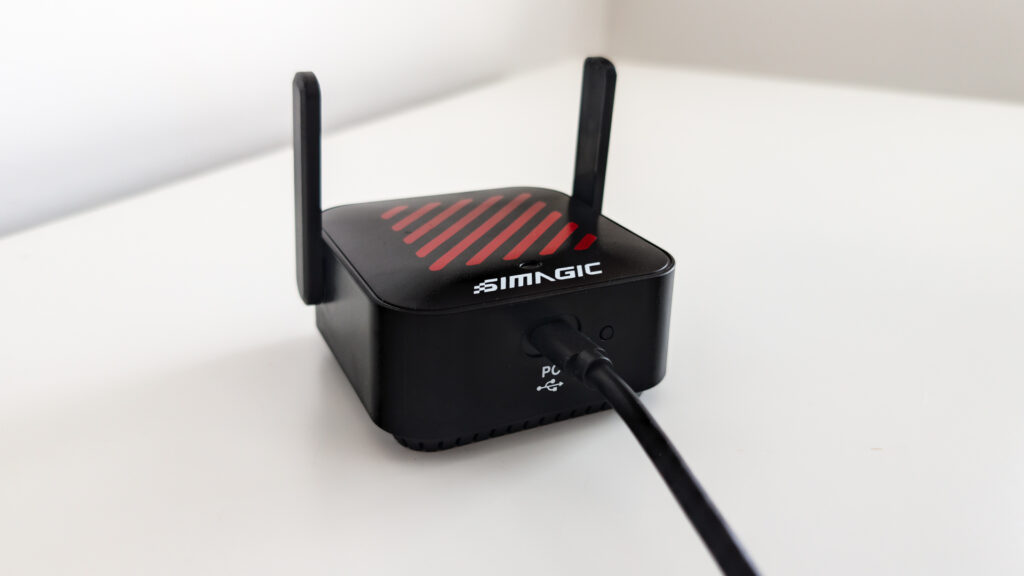
The AirLink doing its thing. Probably.
Ergonomics are typically solid on the Formula and Sport wheels, but the lower paddles on the GT are tricky to grab unless your pinky finger is particularly strong (years of poor guitar playing mean I can grasp the left-side paddle confidently, less so the right). If you have larger hands, you may also feel restricted by the GT and Formula rims’ narrow upper apertures. This isn’t an issue with the Sport, thankfully.
Materials-wise, all use an aluminium chassis with varying degrees of plastic and carbon fibre adornments. Most of the switchgear looks metal but is, in fact, plastic, with Simagic’s familiar button design adding reliable functionality.
For some reason, though, the Formula feels much heavier than the Sport and GT, which could be down to its top-heavy mass distribution, but button access was largely fine. Those with smaller hands may have to stretch a little for some of the lower face buttons, however.
Zeus Formula
Sport and GT
What sets the Sport and GT apart from the Formula, however, is the ability to switch out their wheel rim surrounds. These are available for between $ 49 and $ 89, which seems reasonable.
I was impressed by the quality and feel of the add-on leather-and-suede-covered wheel rims, and immediately fitted the larger-diameter circular suede option to the Sport, which has so far proved ideal for virtual rallying.
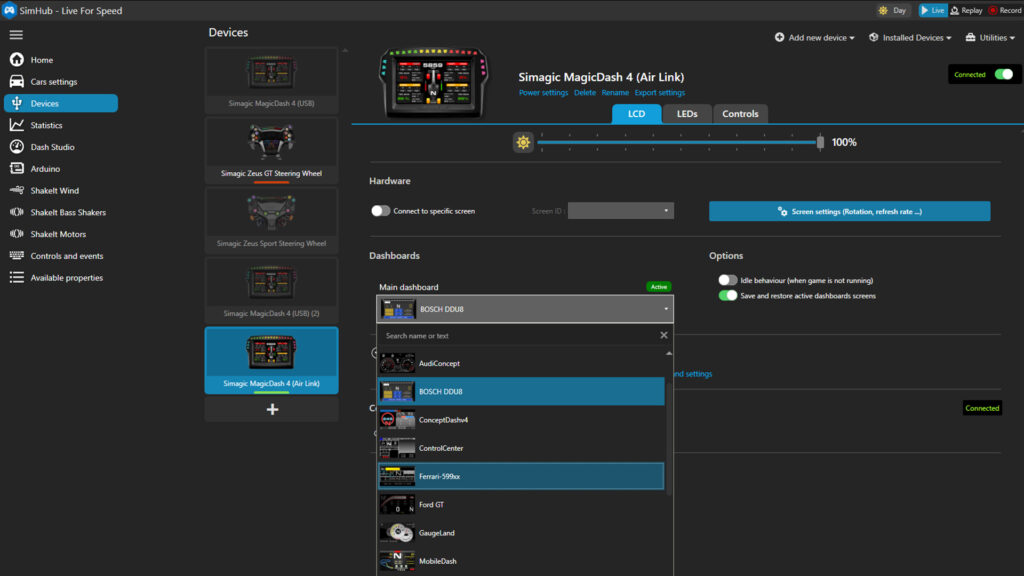
Thankfully, Simagic’s SimPro 3 software is easy to use and set up, with added SimHub compatibility increasing customisability for those who dabble (I got it to work with Live For Speed, which is a real boon for the middle-aged sim racer).
You can also use all Zeus rims on third-party bases with the Simagic QR-A quick release, which is sold separately. Bear in mind, third-party wheelbases will require the MagLink Pro wired connection rather than the AirLink to function.
The GT wheel is 300mm wide, while the Sport is 320mm, offering incremental increases over the Formula. The extra width and more centralised weight distribution offer better feel in my opinion, but the GT is perhaps too compact to be comfortable during extended racing sessions.
For a clearer overview of each wheel, including specifications, scroll down to the bottom of this article.
Zeus GT minus its default gripsZeus GT fitted with optional D-shaped leather grips
MagicDash 4
The MagicDash 4 is Simagic’s long-delayed DDU, which Alpha Evo wheelbase users have been waiting for since the middle of last year.
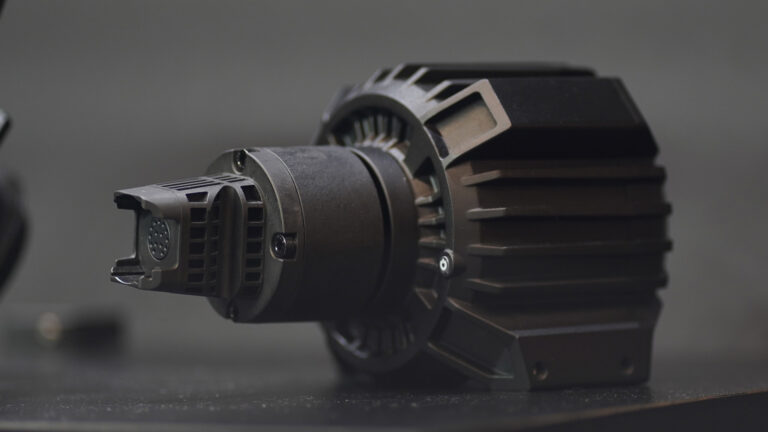
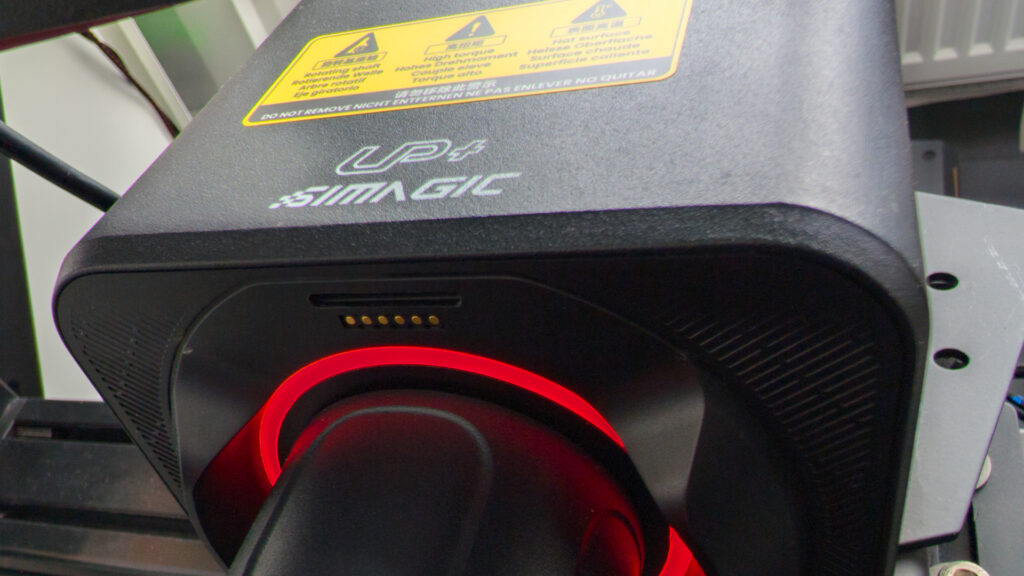
Alpha Evo wheelbases are fitted with a magnetic strip to their front, which the MagicDash locks into perfectly, and it’s the same principle with the Zeus Series wheels. This is where the simplicity ends, however, as getting it working requires an extra step.
Originally, the DDU was configured to receive its telemetry data via your household Wi-Fi, but testing revealed that the connection could be unstable. Therefore, Simagic decided to create its own ‘wireless bridge’, called AirLink.
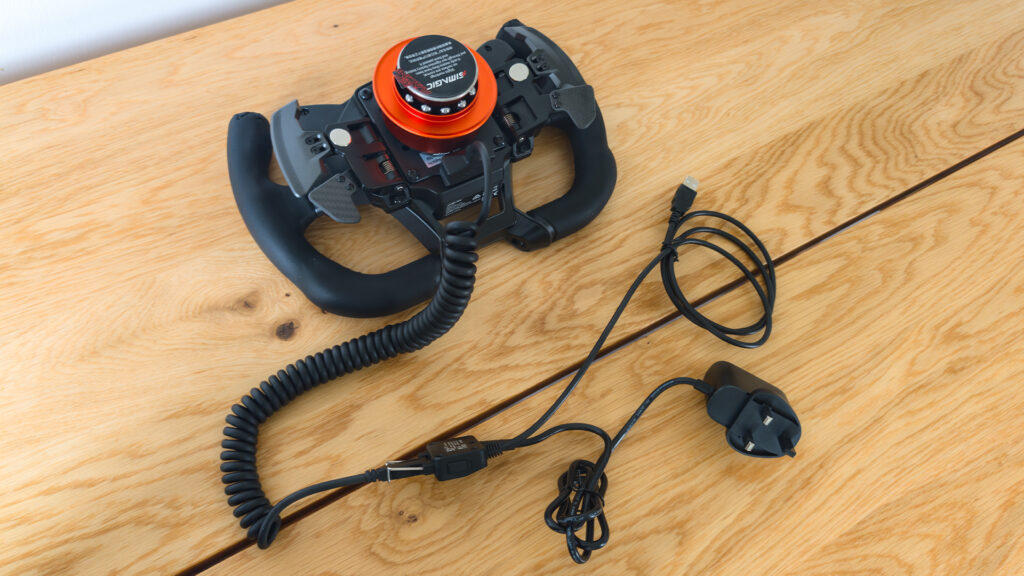
For those requiring a wired connection, Simagic also offers the MagLink Pro, but this involves slightly dismantling your steering wheel and retrofitting additional (but supplied) parts. The result is a permanent connection to your PC, but also a power lead and extra cabling.
For want of a better word, it’s a faff, and feels a little clumsy.
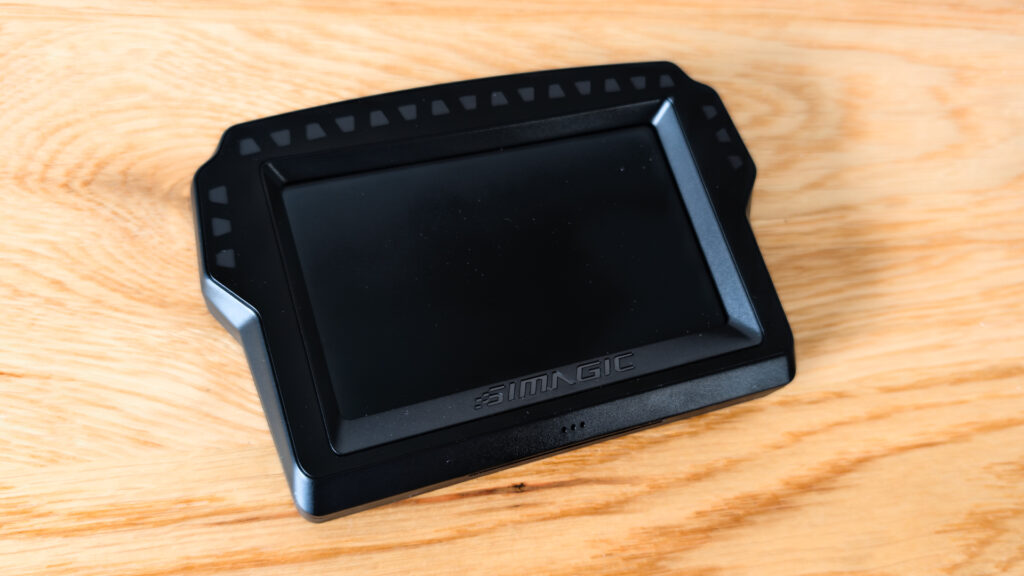
The MagicDash 4 is quite chunky, but robust
Once the firmware is updated, however, it simply works, and the SimPro software is wieldy, making it easy to both customise the LEDs on your wheel and the DDU display (those who prefer using SimHub will be happy to know the MagicDash and Zeus wheels can also be configured here, too, with Simagic currently working on a fix to enable LED control via AirLink).
The magnetic attachment of the MagicDash to your wheel is surprisingly secure, but Simagic does provide an extra retaining bracket to prevent any unfortunate decoupling issues mid-race. For me, though, I opted to run without this as it adds extra unwanted mass – I just have to be careful not to brush against the top of the screen, otherwise it can pop off.
The MagicDash 4 works in Live For Speed via SimHub!
Screen
The MagicDash is a 3.97″ touchscreen with 800 x 480 resolution, which is plenty enough to display detailed information on your wheel. I found the colours to be vibrant and the touchscreen responsive.
Containing 15 top-mounted LEDs to act as a horizontal rev-stripe, plus six side-mounted LEDs (three each side) that can be customised, the MagicDash does everything you’d expect a decent DDU to do.
In terms of aesthetics, the Zeus range’s modular design does mean the MagicDash has chunkier bevels than a ‘normal’ wheel-mounted screen, but it feels appropriately chunky, like it could take some punishment, which makes sense given its rear chassis is constructed from aluminium (the front is entirely plastic, however).
It’s available as a standalone product for $199, and if you buy it with a separate MagDock ($45) you can mount it to third-party wheelbases.
The natural advantage of Simagic’s DDU over its direct Moza CM2 HD competitor is SimHub compatibility, offering far more customisation options at a similar price. The default screen options in SimPro are solid, if unspectacular, alternatives, but that extra depth from SimHub is invaluable to many potential customers.
SimHub elevates the Zeus experience
Price
Simagic’s trump card with the Zeus range is its affordability, or rather, its affordability paired with impressive features.
The Formula steering wheel, MagicDash 4 and AirLink bundle is just $669, not including shipping or additional taxes. The equivalent Sport and GT bundles are $469 and $509, respectively.
At this price point, Simagic’s main rival is perhaps Moza, and the Formula and Sport are slightly more expensive than the comparable Moza FSR 2 formula rim ($649) and the circular Moza RS V2 Steering Wheel ($439). However, the MagicDash’s SimHub compatibility gazumps Simagic’s Chinese rival.
Simagic has maintained its usual high standards with the Zeus range, which feels like the basis of a future-proof PC sim racing ecosystem.
The MagicDash 4 can be fitted directly to Alpha Evo Pro wheelbases via this magentic strip
Although the wheels can’t match the ultimate feel of more expensive brands, this compromise enables a wide range of advanced functions, which is ultimately what most sim racers require.
Sure, I found it difficult to set up the AirLink and MagLink Pro initially, but I’m in a privileged position where I test a wide range of hardware, so for me, chopping and changing sim racing peripherals can be a bit of a chore.
However, for the vast majority of sim racers, the Zeus range will be their go-to for years to come, so that initial effort is more than worth it in the long run.
You can claim 3% off Simagic products by using the coupon code ‘TRAXION’ at checkout.
Traxion has affiliate partnerships through which we may earn commissions on products or services purchased via affiliate links. These do not influence editorial content.





Discussion