
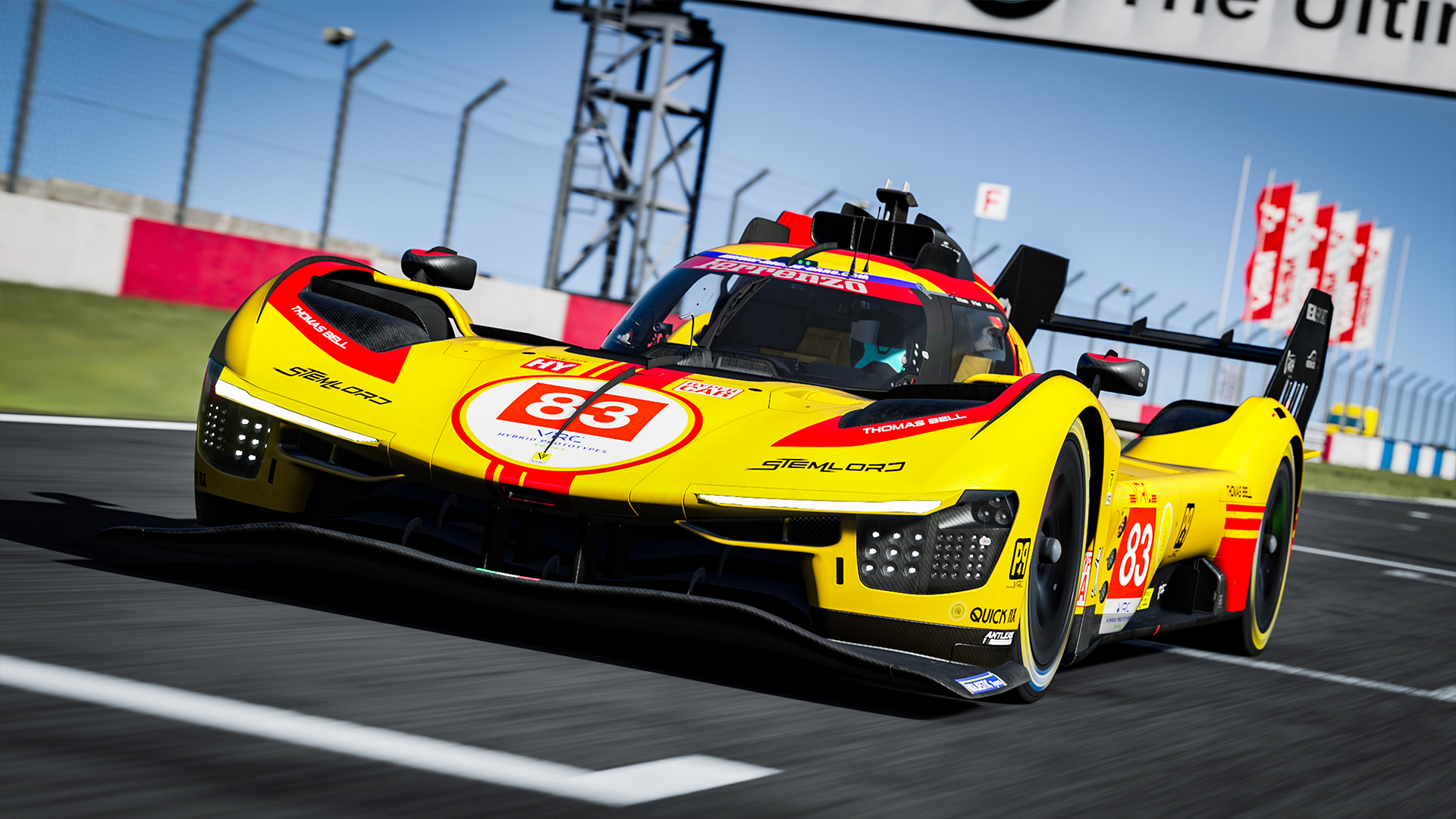
As part of our feature ‘The future of modding in sim racing’, Traxion interviewed Matias Sala, CEO of the Virtual Racing Cars (VRC) modding group.
VRC is responsible for creating countless high-quality mods across Assetto Corsa, Automobilista 2, Project CARS 2 and rFactor 2. The interview was conducted in September 2025.
How did VRC begin? Was modding something you did in your spare time initially?
My personal journey with modding and 3D development started long before Virtual Racing Cars existed. Back in the 1990s, when I was still very young, I was already experimenting with creating simple 3D models on my computer. Around the same time, I was a huge fan of Geoff Crammond’s Grand Prix 2, which gave me my first real taste of simulated motorsport.
By the early 2000s, when Microsoft Flight Simulator 2000 came out, I was fascinated not only with flying but also with modifying the game. I spent countless hours building and customising aircraft models, learning about textures, 3D geometry, and how games handled assets. Later, I also became deeply engaged with rFactor, which was a milestone for the sim racing community and opened my eyes to the incredible possibilities of open modding.
When Assetto Corsa entered its Early Access phase, it became a real turning point. Many of the people who would later form VRC were already active in the community and forums, creating mods as soon as it was technically possible. It was an exciting time, and in many ways it felt like we were helping to shape the foundations of modern sim racing.
What began as a hobby in our spare time grew steadily into something much bigger. The quality of the work, the feedback from the community, and eventually the collaborations with professional drivers and teams pushed us to take things more seriously.
Over time, that passion evolved into what is now Virtual Racing Cars: a professional studio developing content that is used worldwide by sim racing enthusiasts and motorsport organisations alike.
What is the most challenging part of working on sim racing mods today?
The most difficult part today is how incredibly complex everything has become compared to the early days. Back then, with rFactor or the first versions of Assetto Corsa, if the car looked good and felt fun to drive, people were satisfied.
Now, the expectations are much higher—the community demands content that is not only on par with official developer work, but in many cases even more complex.
The 3D models we create now are massively more detailed than before. Suspensions are fully modelled and animated, interiors have a huge amount of small details, and the accuracy goes down to components that most people wouldn’t even notice at first glance.
On top of that, physics need to be as close as possible to the real car, sounds are expected to be recorded or engineered with extreme accuracy, and LUA scripts add advanced features such as ERS deployment, plank wear, or brake mapping. And all of this still has to run smoothly on many different systems.
So the hardest part is meeting these very high expectations. It’s no longer just a matter of making something that looks good; it’s creating highly detailed, technically advanced, and optimised content that pushes the limits of what a simulator can handle.
How long does it take to create a car mod from start to finish? For example, one of your Hypercar mods?
Nowadays, creating a mod from start to finish can easily take up to a year. For example, we’ve already announced that very soon we will be releasing the Formula Alpha 2025 [which has since been released], and the truth is that we’ve been working on it since 2024.
It’s practically been a full year of work on this new car, because it requires an enormous amount of coding hours and the development of new algorithms to simulate in the most realistic and faithful way all the car’s physics and also all the electronic systems, which today are extremely complex.
As I mentioned before, making a mod today is not just about doing the sounds, the physics, and the 3D model, we also have to program the electronics of the car in depth, and we work on the physics with a much higher level of complexity than in the past. That’s why it takes so much time.
In other cases, from the moment we start gathering references for a car until it finally sees the light of day, it often ends up being close to a year. And sometimes people in the community comment that we release a car when it’s already not so “new” anymore, or that we happened to release the same car at the same time as another modding team.
The reality is that development takes so long that people often think we started working on it just recently, but in fact, we usually began so far in advance that no one saw all the work that had been going on behind the scenes.
The development time also depends a lot on the complexity of each project. If we’re working with a team that can provide references, it’s one thing, but sometimes we only have photos, and in other cases we might be lucky enough to get a full 3D scan of the car. The same goes for sound: sometimes we receive recordings directly from teams, but other times we don’t, and that makes the process of gathering references much more complicated.
So, in short, it usually takes around a year to develop a car, with the timeframe depending on how complex the project is and the kind of references we are able to access.
How difficult is it to find reference materials to help create a mod?
Today, depending on the project, sometimes it’s easier and sometimes it’s harder to find reference materials to create mods.
There have been certain occasions where we worked directly with professional teams or drivers, and in those cases they provided us with CADs and very precise physics information, taken directly by them or their engineers. In those situations, the reference-gathering process is much quicker, the direction is clearer, and the whole development moves forward faster.
In other cases, the reality is that we have to work with very limited references: searching online, going into forums, and trying to contact people who may have access to the cars. That’s when things become more complicated and take much longer.
Sometimes we’ve also worked with partners… in countries where the car is located or easier to access. They can go and photograph it for us, or even reach out to a team directly, make an arrangement, and obtain specific information that would otherwise be impossible for us to get.
Another difficulty for us is that many members of VRC are from countries outside Europe and the United States. That means we often face problems accessing cars that are only seen or raced in the so-called “first world.”
For example, all the touring cars we’ve worked on are cars I have never seen here in Argentina, and they are extremely difficult to access. Having partners in Europe who support us in that way has been very important and has helped us a lot.
Have you worked directly with developers to create cars for their sims?
Yes, some of the people who are part of VRC today have worked directly with developers like Kunos Simulazioni, Studio 397, or others. Because of NDAs, we can’t really mention which cars or which projects.
What I can say is that those experiences were very valuable, because they gave us a lot of insight into how things are done officially, how the workflows are organised, and what kind of quality standards are required.
Even though the names of the people involved or the specific projects are not public, the knowledge and experience they gained are part of what we apply today in our own work at VRC.
Did VRC’s input into the above sims extend further than just car modelling?
The truth is that all the members of VRC’s core team have been involved in the Assetto Corsa modding scene since very early, even before version 1.0, back in the Early Access days.
At that time, we had quite a close back-and-forth with several members of Kunos. So while I can’t point to one specific bug or one specific feature we directly created, we did participate in very interesting discussions about the physics as they were being developed.
Being in direct contact with some of the developers also meant we were able to request certain features, and some of those eventually made their way into the sim over time.
With Studio 397 it was similar: we had a fairly direct line of communication at one point, and I personally reported several bugs, especially related to the Dev Mode in rFactor 2. A lot of that happened when we were working on the official Super TC2000 mod for Argentina.
But shortly after that, rFactor 2 was more or less abandoned by the company, and there were many internal changes. So maybe some of that feedback was being worked on at the time, but in the end, it never really saw the light of day.
How do you think sims like Project Motor Racing, Assetto Corsa EVO and Rennsport having final approval over mods will affect your work? Will this make producing mods more challenging in future?
Having to go through an approval process means there will be restrictions and maybe longer waiting times before a mod can be released.
But at the same time, it could also be an opportunity if it is done properly. Everything will depend on how the approval system is organised. If it is fair and clear, it might even open doors for modders to work more officially with manufacturers.
Of course, it’s very different when a manufacturer comes to you asking for a mod, compared to when you have to go to them and request a license. That’s why it’s hard to say exactly how it will work until we see these systems in practice.
Would you consider trying to obtain licenses from manufacturers for your mods in this case?
Honestly, this is still very speculative. There’s not much that can be said for sure yet. We have worked with manufacturers before, but what often happens in those cases is that the mods end up being released by them, and you don’t even get public credit for the development. The work remains kind of anonymous.
I also believe that commercial licenses for mods are usually extremely expensive. And nowadays, especially after the pandemic, many car companies are much more aware of what mods are and how simulators and video games are used. That has made the prices for licenses even higher. Again, this is all still speculation, but the reality is that obtaining commercial licenses is very complex. It is very different when a company approaches you to request a mod than when you have to approach the company and ask for a license.
For example, when we worked on the official rFactor 2 Super TC2000 mod, we were able to include the official licenses and the car brands. But again, that wasn’t a project where VRC was named; it was a development for a third party, and they were the ones who released the mod, not us.
So once again, it’s all still speculation. We need to wait and see how the approval systems for these new platforms are actually implemented. The fact that Kunos is involved [with Assetto Corsa EVO] might help, because if things are more public and transparent about how the mod will be used or sold, it could make it easier for small studios like ours to approach big manufacturers and work on licensed content.
But for now, it’s too early to say, and we have to wait until everything is clearer.
Continuing on the above topic, does the potential size of the console mod market excite you as a studio? For example, Project Motor Racing’s ModHub.
Yes, the idea of a console mod market is very exciting. It would give us access to a much larger audience, many people who don’t play on PC and have never had the chance to experience mods before. If the system is well designed, it could be a big opportunity for studios like ours.
At the same time, we have to be cautious. Consoles always have stricter rules and less freedom compared to PC, so we need to wait and see how much flexibility creators will actually have. If it’s handled in the right way, it could be a huge step forward. But until we see how it is implemented, we can’t really say for sure.
Do you see VRC continuing to develop mods for Assetto Corsa, rFactor 2 and Automobilista 2 in the long term?
For the public side, Assetto Corsawill definitely remain our main focus. It still has the biggest community, the most open modding tools, and even after so many years, it is very much alive. That is why most of what we release publicly continues to be for Assetto Corsa.
With rFactor 2, we actually had mods in development at different stages. But the reality is that the platform lost a lot of momentum, and the company behind it didn’t really continue to support it in a way that would make it sustainable for us.
So many of those projects ended up paused or cancelled, even though we had already put significant work into them.
In the case of Automobilista 2, we were in contact with Reiza and we looked seriously at the possibility of developing there. But the truth is that the limitations for modding are very strong, the documentation is lacking, the tools are not as open, and the support is very limited.
That makes it extremely complicated and unattractive compared to what can be done in Assetto Corsa.
And of course, what the public sees is only part of what we do. We also develop private content for professional teams and simulator companies, and many times these are simulators that the general community doesn’t even know about. Having the chance to work on those projects has been very interesting and has given us experiences that we could not have had otherwise.
So in the long term, Assetto Corsa will stay as our main public platform, but beyond that we will keep working on professional projects and adapt if new platforms appear that truly support modding.
What can we expect to see from VRC in future?
I don’t want to talk too far into the distant future, but what I can say is that we are in a process of growing and also evolving as a studio. We are developing a lot of content for different simulators; sometimes not the most popular or public ones, but also for more closed simulators that professional teams use.
On that side, VRC will probably continue to grow more into the professional area, working with racing teams, big companies, and professional drivers.
On the other side, we will of course continue to develop mods for Assetto Corsa for quite some time. We will keep supporting our existing mods, and we also have plans to relaunch some of our older mods with updates that include all the new features of CSP, as well as improvements in physics models, sounds, and Lua scripting.
At the same time, we are not only focusing on sim racing for the public and for professional racing teams, but we are also very interested in expanding into the development of assets for video games in general.
Recently, for example, we had the chance to collaborate on a new game called Formula Legends, which will be released soon [the game released in September, 2025], contributing assets, sounds and support. That experience showed us how much potential there is in bringing our know-how into different kinds of racing games, not only pure hardcore simulation.
We are also preparing for the next generation of platforms like Assetto Corsa EVO, Rennsport, and Project Motor Racing. We are following their progress closely and getting ready to adapt when the time is right.
Of course, everything we do will always stay within the world of racing and motorsport, because that is what we are most passionate about. And what will never change is our philosophy: accuracy, quality, and passion for motorsport.
Whatever direction sim racing takes, you can expect VRC to keep pushing forward, working with the same dedication we have had from the very beginning.
Featured image courtesy of Simracingcockpit


Chat with the Community
Sign Up To CommentIt's completely Free