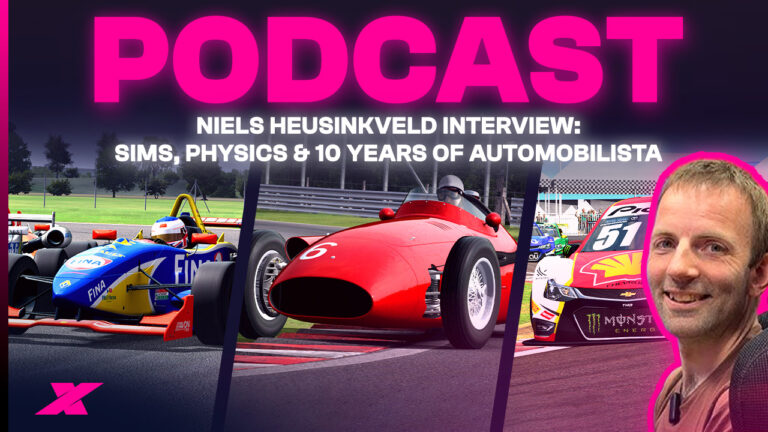
Although nowhere near as commercially successful as its sequel, we examine the merits of Automobilista 10 years on from its release, featuring input from physics lead Niels Heusinkveld.
It’s been 10 years since the release of Reiza Studios’ Automobilista (AMS), a racing sim that offers a diverse range of cars and tracks, and tactile handling dynamics.
The Brazilian developer started off making mods for the likes of rFactor, leading to commercial projects like Formula Armaroli, an ’80s Formula 1 car designed in collaboration with simulator manufacturer Armaroli Design (a car that looked suspiciously like Ayrton Senna’s McLaren MP4/4, no less).
Buoyed by this critical success, Reiza, headed by Renato Simioni, produced its first game in 2011. Game Stock Car may not have had the most inspiring title, but it showed enormous potential. It also brought Brazilian motorsport to a new audience thanks to its Stock Car Brasil licence, featuring faithful renditions of several South American circuits.
Subsequent releases, Formula Truck (2013), Game Stock Car Extreme (2014) and the freeware Copa Petrobras de Marcas (2014), cemented Reiza’s position as a studio on the up, with Automobilista arriving in 2016 after a successful crowdfunding campaign and Early Access phase.
Despite the release of Automobilista 2 in 2020, many still view its predecessor as the zenith of the studio’s output.
Find out why below.
Origins
Like most of Reiza’s output, AMS was built on Image Space Incorporated’s gMotor2 game engine, sharing a basis with rFactor and a glut of SimBin’s noughties output, including GTR 2, GT Legends and Race 07.
gMotor2 made complete sense as a starting point for Reiza, considering Simioni’s experience working on SimBin’s Race On, STCC: The Game and GTR Evolution offshoots.
However, AMS went beyond these previous titles, offering dynamic track evolution and several audio and visual tweaks to raise it above its nearest cousin, rFactor.
Drifting around a private jet. Standard stuff.
Although rFactor 2 was available in 2016 using a modified version of gMotor 2, its rough early builds and muddled usability made AMS a more attractive prospect in many regards.
However, its handling model was immediately marked out as genre-leading, with renowned physics specialist Niels Heusinkveld pulling the strings. Consequently, this led to tyre and throttle model improvements, and the game’s physics refresh rate was bumped from the standard 360 Hz found in rFactor up to 720 Hz, which, in simple terms, offers more accurate physical feedback through players’ steering wheels.
This is the main appeal of AMS: its diverse roster of cars feels intuitive to drive.
Physics is fun!
Intuitive
Grand Prix Legends heavily influenced Heusinkveld’s early sim racing adventures, but his reputation really grew during the halcyon days of rFactor, helping create superbly realised Honda NSX-R (with Siim) and Historx mods.
Thanks to a licence agreement with SimBin, Historx had permission to use the studio’s car models, with a DVD check required before installation. The result was one of the most comprehensive, authentic and fun driving experiences in rFactor.
Similarly, driving in AMS feels like putting on a pair of comfy old slippers. Its cars are lively, and you can instantly feel when they’re about to break traction; it’s instantly immersive. Driving a downforce-laden Formula 3 car is one of my favourite experiences; unsettling the car into a high-speed turn can be controlled with a subtle dab of opposite lock, while power-oversteering a Brazilian stock car feels magical.
It’s not all rudimentary circuit racing, however, with rallycross, drifting and the bonkers Supertrucks offering very different challenges. There’s even a slippy snow-laden track in the form of the Buskerud Ice Circuit. Each car and discipline has its idiosyncrasies, but they are also, crucially, great fun to drive and cohesive in their dynamics.
A large part of this is down to Heusinkveld’s spreadsheet-based physics steeped in mechanical theory, but it’s also down to Simioni securing ISI’s source code, helping elevate AMS’s handling model above the likes of rFactor and GSCE.
“With AMS, we had the [ISI] source code that we could modify,” explained Heusinkveld. “And that of course makes it really interesting because you can add stuff. However, it also makes it difficult because here is a tiny dev team with no previous experience of working with C+ [programming language],” he continued, describing both the tremendous opportunity presented to Reiza and the difficulty involved.
“And Dom [Domagoj Lovric, Audio Engineer], for example, discovered, ‘Wow, there is reverb. We didn’t know that.’ So he started enabling that and adding a bunch of effects.
“And Alex [Sawczuk, Lead Environment Artist / Software Engineer],… ‘Well, we can do like rubbering driving lines and stuff’,” referencing AMS’s dynamic track rubbering mechanic.
But adding complicated features soon took its toll: “So the desire to go mad with adding new features sometimes outpaced the quality control a little bit, and we had some issues,” explains Heusinkveld.
Racing games need more diesel fumes (and less ‘Trucker’s Tizer’)
“I did a new throttle model… and we worked on that and everything was just a bit difficult because we simply didn’t have the experience… I could barely read the source code and the physics was quite new for me back then.
“So it’s a shame in hindsight because… we were sort of in the deep end and we got enthusiastic and we just lacked the size and experience,” he lamented, sensing missed opportunities with the benefit of 10 years of extra knowledge.
AMS’s Mendig map had hints of a semi-open-world to it, although Heusinkveld says this was never meant to be expanded upon
Multiplayer
In terms of full-time employees, Heusinkveld reckons there were just a handful of people working for Reiza at the time, not including outside contractors. Considering these limitations, Reiza managed to cram a huge variety of cars and tracks into the game.
Not only does it feature Brazil’s premier racing series, but it also includes two distinct Dallara F3 single-seaters, several varieties of touring cars, karts, trucks and several generations of Formula 1 cars.
However, much of the content is unlicensed and recycled from Reiza’s previous titles, and most vehicles are from championships little-known outside of South America; while AMS had Copa Uno, Assetto Corsa continued to secure glamorous Porsche and Ferrari licences. Crucially, for a modern racing sim, there are no GT3 cars (outside of mods), which may well have affected the sim’s long-term appeal.
Likewise, the game lacked a multiplayer matchmaking feature in its nascent stages, though a 2017 update introduced a rudimentary driver ranking system. With ‘Race Rank’, players could increase (or decrease!) their driver ranking using a system weighted against the strength of the opposition, the field size and the race length.
Whether introducing this from the get-go would have dramatically increased the game’s peak concurrent player count of 497 on Steam is up for debate, but it surely would have helped.
The RaceDepartment Mini Challenge was the absolute peak of sim racing esports (unbiased opinion)
In many respects, AMS was a missed opportunity for Reiza. Despite an immersive driving experience, it lacked crucial features like dynamic weather and a fully formed single-player career mode, meaning the game became only a cult favourite among a few well-supported racing communities rather than a full-blown success story.
For me, the highlight of my sim racing career was the RaceDepartment Mini Challenge, which offered scintillating wheel-to-wheel racing alongside some talented drivers. Practising for each round was a joy thanks to the game’s moreish physics: I just felt so in tune with the car and its behaviour.
The game’s advanced turbo model also helped me set the fastest PreQualifying time at Suzuka, as I realised that instead of revving the car out in third gear into Dunlop corner I could shift up into fourth and use the extra torque to gain a couple of tenths.
It must also be said that the sim offered an excellent platform to showcase some hidden motorsport gems, too, with tracks like Campo Grande, Cascavel and Goiânia just three of the incredible circuits many sim racers are unfamiliar with.
Offline, you can run full seasons using the Stockcar Brasil cars and many other default cars, but it’s also possible – with a little legwork – to create custom championships. It’s a nice feature, but while the game’s AI is largely raceable, it’s perhaps still too inconsistent to sustain long-term interest.
The game’s default singleplayer championships are clunky but functional
Set apart
So, with divisive content, an older game engine and relatively low player numbers, what set AMS apart from its competitors in 2016?
“Yeah, maybe that’s the problem – not enough, I think,” answers Heusinkveld.
“It handled very well, and for a lot of the cars I feel it was competitive and in some ways ahead of AC. And also, I feel [it’s] ahead of some rFactor 2 content, which would be too slidey…
“So at this point, all the other sims had their flaws, and our handling flaws were, I don’t think, any worse and, in some cases, better than the others. But we focused on our passion, which was the sound and the track rubbering and the physics,” he concluded, citing Reiza’s focus on the game’s overall driving experience.
As Heusinkveld alludes, perhaps the biggest issue for AMS at the time was competition from Assetto Corsa, rFactor 2, iRacing and RaceRoom, all of which were getting into their stride 10 years ago.
Despite its flaws, AMS still has an enthusiastic following. For example, the ‘Vintage Motorsport’ community has recently added a dynamic weather system as part of its ‘Quality of Life Project’ for the game, with enhanced AI and ‘more realism’ also promised in future.
If you ignore the final corner, this was almost a decent lap
The game remains a favourite with historic racing fans owing to its diverse range of classic content (not to mention accompanying livery packs featuring authentic paint schemes), but most impressively it remains an intrinsic part of real-world motorsport, with at least two Formula 2 teams and two Supercars teams using AMS to train their drivers, according to Heusinkveld.
Heusinkveld has worked with F2, Formula 3, Formula 4 and GB3 team Rodin Motorsport on its simulators, and has received largely positive feedback on how AMS feels to drive, further validating his and Reiza’s work.
Rodin driver Emma Felbermayr using Automobilista during a recent F1 Academy video (that we can’t show, booooo FOM!)
Beyond AMS
AMS’s final major update arrived in September 2019, adding Donington Park and Snetterton to the game. From this point forward, Reiza’s focus shifted to its sequel, Automobilista 2, and away from ISI’s proprietary tech.
It was decided that Slightly Mad Studio’s MADNESS engine would be the basis for the next game, and there were a few reasons for this.
It presented Reiza with an opportunity to release consistent content with fewer back-end tweaks required to get it working. It also enabled the studio to harness MADNESS’s superior visual prowess – inlcuding genre-leading VR – and it contained advanced features like dynamic weather.
However, before the transition, Heusinkveld decided to part ways with Reiza to focus on his growing hardware business, Heusinkveld Engineering, which he’d set up with his friend Svend van der Vlugt.
“It was fairly clear that AMS had limitations,” explains Heusinkveld.
“It’s a 32-bit game, so four gigabytes of memory is all it can use… and the amount of work we had to do to the source code to bring it up into modern times would have been insane and out of the realm of possibility,” he offered, indicating why AMS’s old tech was not an option for AMS 2.
“And then Renato was talking to – I’m pretty sure – rFactor 2 to see if we could use that engine. So he investigated that and I’m sure he talked to Ian Bell [CEO of SMS] and at some point that came to be the choice that they made.
Buskerud’s ice required a few tweaks to get working, but nothing major
“This was not… for physics reasons because nobody’s felt AMS drove badly, and it could still be improved with better tools and some adjustments, but in so many other ways, and it’s so clear if you play AMS 2 now, of course, it is ahead in many, many ways compared to AMS. So it was the right choice.
“[The] problem was, however, it’s no longer the same physics engine. Parts of it are still the same, but there’s a completely new tyre model in the MADNESS engine.
“And before you can make your good content, it can easily be a year of full-time work. And what I felt was gonna happen, and it’s not something I would prefer, is you start to chase [deadlines]. It becomes sort of a stressful thing because you’ve got no [deep enough understanding of the physics engine to make content efficiently],” he continued, explaining his exit from the Reiza development team.
Heusinkveld is pragmatic and accepts the game engine decision was ‘a very realistic business thing,’ but with Heusinkveld Engineering also demanding more of his time, it seemed like a natural stopping point.
With hindsight, Reiza’s decision to switch to MADNESS makes great financial sense; after all, AMS 2 sold over 200,000 copies in one Steam Sale period alone, but one wonders if its divisive physics would have benefited from Heusinkveld’s input.
It’s a moot point now, but the split was at least amicable.
GPLaps’ Jake William demonstrating the enduring appeal of AMS’s historic content
Golden age
Although sim racing has progressed in many ways over the last decade, one feels that a sim like AMS wouldn’t be made today.
It may not have the nicest UI, or a huge budget behind it. but the game prioritised its sublime handling model and driving dynamics over glitzy visuals and licensed content. In this respect, AMS has a lot in common with the likes of Richard Burns Rally and Live For Speed: old sims that drive incredibly well and are championed by passionate players.
AMS’s physics and handling model undoubtedly stand the test of time, and although its visuals lack modern graphical bells and whistles, it still looks clean to this day (and there are zero performance issues on mid-range PCs!).
Neils Heusinkveld wants you to know that this is not a Maserati 250F. No.
Mods also help keep the game fresh, especially as rFactor’s huge range of add-on tracks are easily converted, and some of Heusinkveld’s passion projects also showcase the potential of AMS.
Ten years on, AMS punches well above its weight in terms of sim racing physics and driving enjoyment, but one wonders if a spiritual successor will arrive.
The modding community is alive and well in AMS in 2026
“I have quite a clear image in my mind how I would approach physics for a new sim,” said Hesuinkveld.
“So maybe at some point a door opens and yeah, this passion of mine with physics and my theories of improving consistency, car to car, it might become a reality. But there is nothing on the horizon, and it might never happen.
“I’m open to the idea in the future, very much,” he concluded, tantalisingly.
Amazing article and video. Really helps to put AMS legacy into perspective. Me, for example, started simracing with the pandemic and at the time did not payed much attention to AMS 1. I love AMS 2 and bought the first game during a Steam sale just to appreciate Reiza, but never put the time on it. Maybe you guys could put together a guide on “how to AMS1 in 2026”, focusing on make it work with modern hardware, install mods and etc. I would love to see something like that.
As Traxion’s resident AMS fanboy, I’d love to do this! The thing is, it already runs really well with good-quality modern hardware and mod installation is super easy too, so there probably isn’t enough demand for guide content, sadly 🙁




Discussion
Amazing article and video. Really helps to put AMS legacy into perspective. Me, for example, started simracing with the pandemic and at the time did not payed much attention to AMS 1. I love AMS 2 and bought the first game during a Steam sale just to appreciate Reiza, but never put the time on it. Maybe you guys could put together a guide on “how to AMS1 in 2026”, focusing on make it work with modern hardware, install mods and etc. I would love to see something like that.
As Traxion’s resident AMS fanboy, I’d love to do this! The thing is, it already runs really well with good-quality modern hardware and mod installation is super easy too, so there probably isn’t enough demand for guide content, sadly 🙁