Racing isn’t all about the breakneck speed usually associated with motorsport. One of the key differentiators between a good driver and a great driver is how they remove said speed.
Braking is a critical component of lap time. Scrubbing off pace isn’t simply a matter of hitting the brake pedal to its maximum travel. It’s about timing, it’s about nuance and it’s about control.
Consequently, one of the most important elements to a sim racer’s experience is brake feel. Be that the sensitivity of the brake pedal, the firmness, the precision of movement or the material quality. It helps the driver master the braking zone and find those tiny tenths or hundredths of a second that make the difference.
Sometimes in sim racing, there’s a lot of talk about wheels and wheel bases, which are undoubtedly important, but pedals can be overlooked. An ideal set can make a significant difference, and it’s why CONSPIT has rapidly evolved its CPP EVO setup to the CPP EVO V2.
What is the CONSPIT CPP EVO V2?
Range-topping hydraulic sim racing pedals
Available as a complete set or an individual pedal upgrade
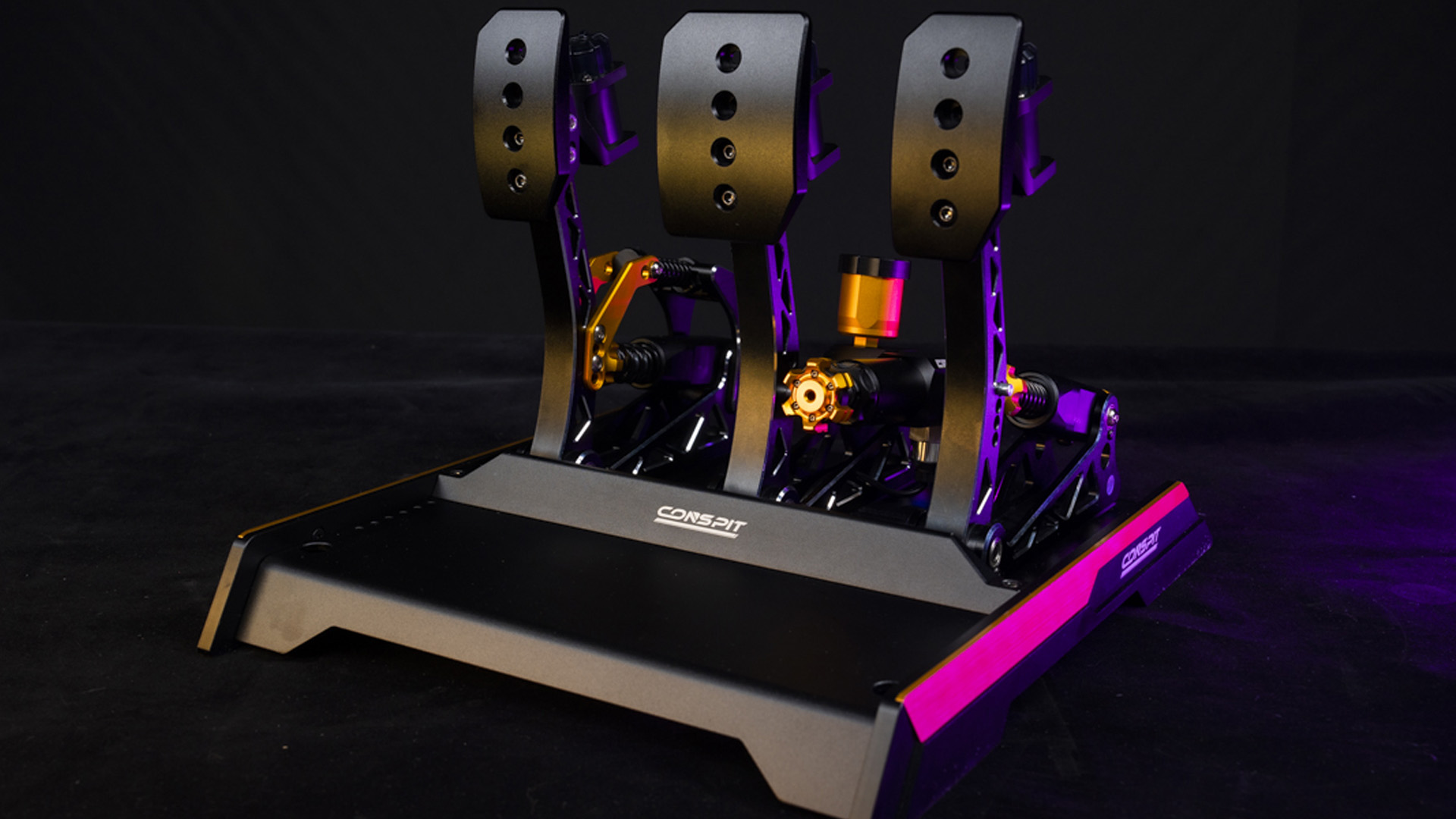
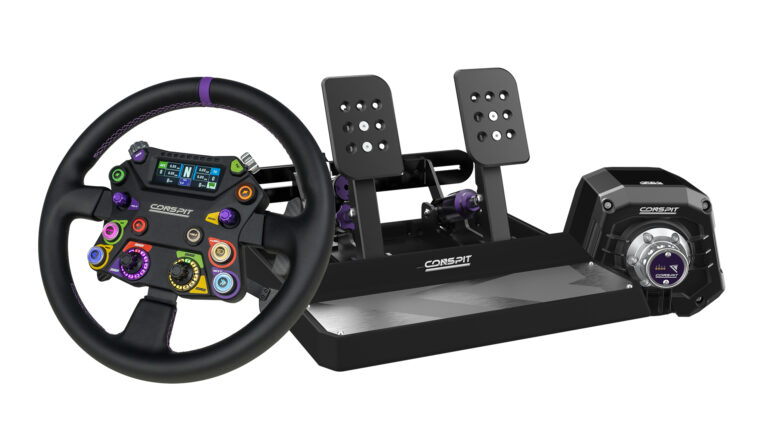
In the simplest of terms, the CONSPIT CPP EVO V2 is a set of sim racing pedals, with a key differentiator of a hydraulic braking system.
It’s available in two sets: EVO V2 two-pedal set (throttle and brake for $749) or EVO V2three-pedal set (throttle, brake and clutch for $849). The clutch pedal can be purchased separately ($140), and so too, the EVO V2 brake pedal ($349) for existing CPP EVO owners.
While a more traditional load cell-equipped input is capable of providing an authentic experience, a hydraulic setup is closer to many real-world race cars. That’s why the current CONSPIT range, which also consists of the CPP Lite and CPP Apex models, is hydraulic-only.
Each car is different, and drivers have their own setup preferences. Compared with conventional elastomer-based load-cell pedals, the CPP EVO V2 uses a hydraulic system to generate and measure braking pressure, creating a distinctly different pedal response. Your braking performance depends mostly on the amount of pressure you apply, as opposed to the pedal’s travel.
Anecdotally, several high-end professional-grade race simulators used by race teams are likely to use a hydraulic brake pedal.
Hydraulic braking system overhaul compared to ‘V1’ model
Designed to smooth out inputs for finer modulation
Now we understand why the CPP EVO V2 sits atop the CONSPIT range and uses a hydraulic braking system, let’s look at the recent improvements that make this a ‘V2’ compared to the previous ‘V1’ model.
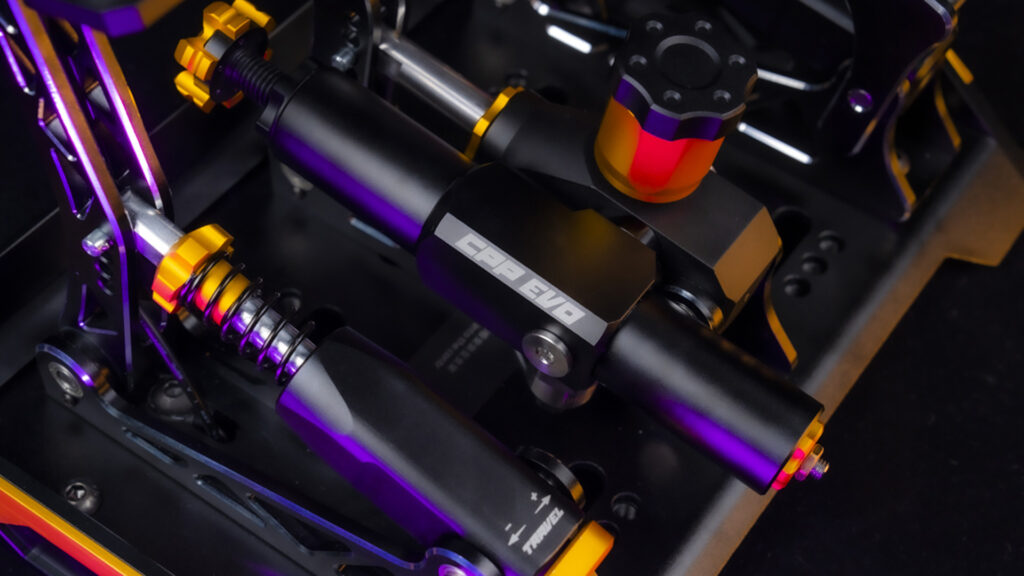
The key change is inside the hydraulic system. The aluminium piston has been replaced with one made from steel that’s then chrome-plated. Then, the prior polyurethane seal is no more; instead, there’s a dual step-seal structure that uses a polytetrafluoroethylene (PTFE) sliding ring in combination with an elastic O-ring.
You can spot the V2, compared to the V1, with a longer elastomer cylinder design.
That sounds quite complex, but in essence these two changes result in, according to CONSPIT, greater wear resistance and reduced friction. And why is that important?
Well, it’s vital for a sim racer that they can rely on the brake pedal. They need to know that the feel will be consistent and in line with expectations every single time they press it. Increased wear resistance means enhanced durability.
The reduced friction from this newer design enhances braking technique too, as the ~50 per cent smooth pedal return (compared to the’ V1’) opens up greater brake modulation possibilities. Smoother inputs can reduce the chances of locked wheels, or unsettling weight transfer and (depending on the car and track combination) improve the ability to trail brake.
Comprehensive adjustment
Mechanical and software settings
M-DVF vibration module included as standard
That’s a lot of focus on the deep internal upgrades, but the V2s also include several other interesting features.
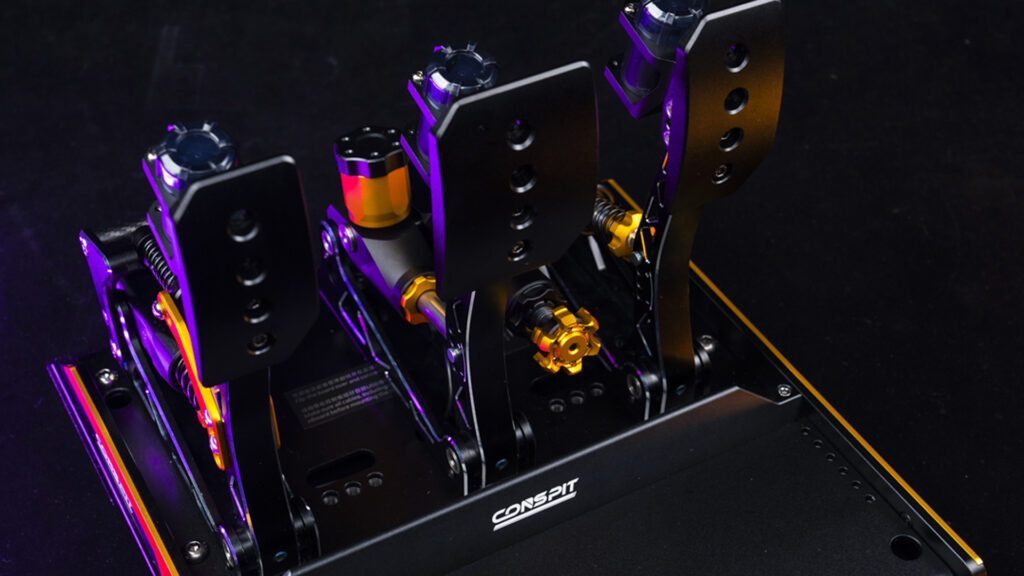
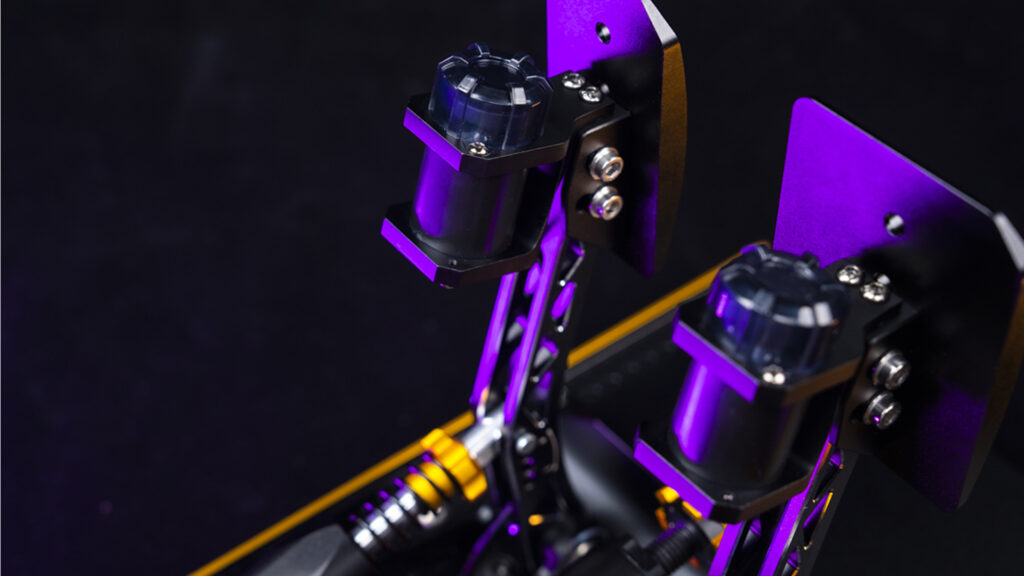
The pedal units are Computer Numerical Control (CNC) machined aluminium alloy, allowing for an intricate hollow design built to tiny tolerances. These are finished with a finish that’s both anodised and sandblasted, for not only a distinctive aesthetic, but one that CONSPIT claims is robust.
Being able to tweak your pedals is imperative, matching the feedback and performance to that of an individual’s preference.
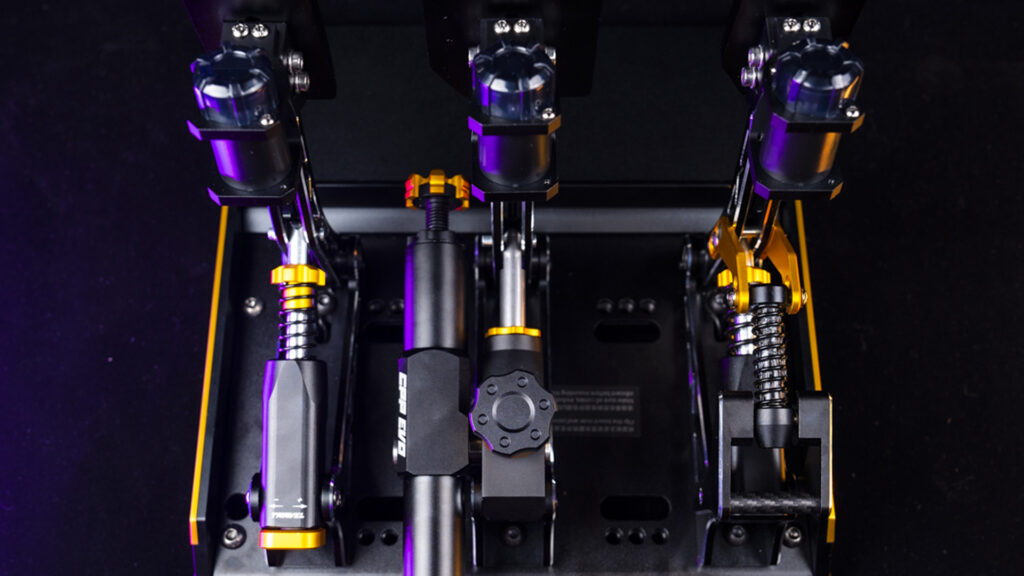
In this regard, the throttle, brake and (optional) clutch pedal have several options:
Throttle: Four levels of pedal force, adjustable pedal travel and spring preload
Brake: Four levels of pedal force, independent preload for front and rear stages
Clutch: Adjustable spring preload and four-position bite-point adjustment via the upper linkage
Then there’s the CONSPIT Link 2.0 software, where the mapping curves (for the ratio between your input and the brake’s response) and input limits can be adjusted.
Once preferences have been adjusted and saved, CONSPIT includes the M-DVF Vibration Module.
Pre-installed to the rear of the brake pedal, the system simulates braking cues such as the locking of wheels and traction loss through haptic feedback. These support customisation settings via popular third-party SimHub software, too.
So, there’s the significantly updated hydraulic system, the CNC-milled structure and several individualisation options either physically or through software.
That’s before we mention the CONSPIT CPP EVO V2’s updated spring and elastomers for broader customisation, new polytetrafluoroethylene (PTFE) bushing on the throttle and clutch push-rod guides.
Combined with the uprated 200 bar hydraulic sensor, CONSPIT has worked hard to take onboard community feedback and deliver a pedal set that provides predictable and smooth inputs time after time, helping towards consistent lap times.












Discussion