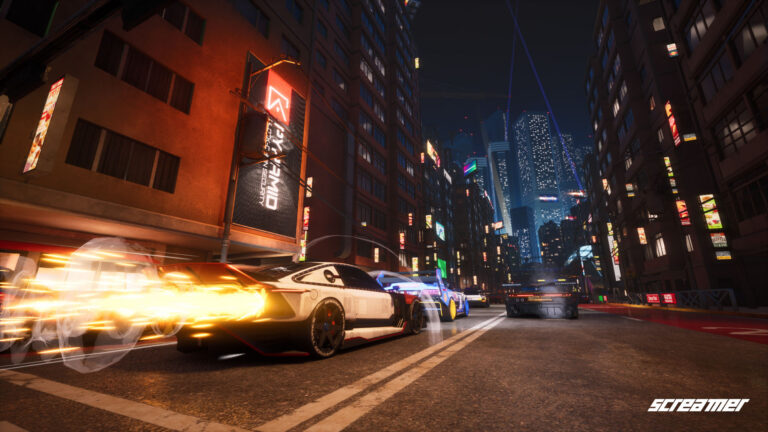
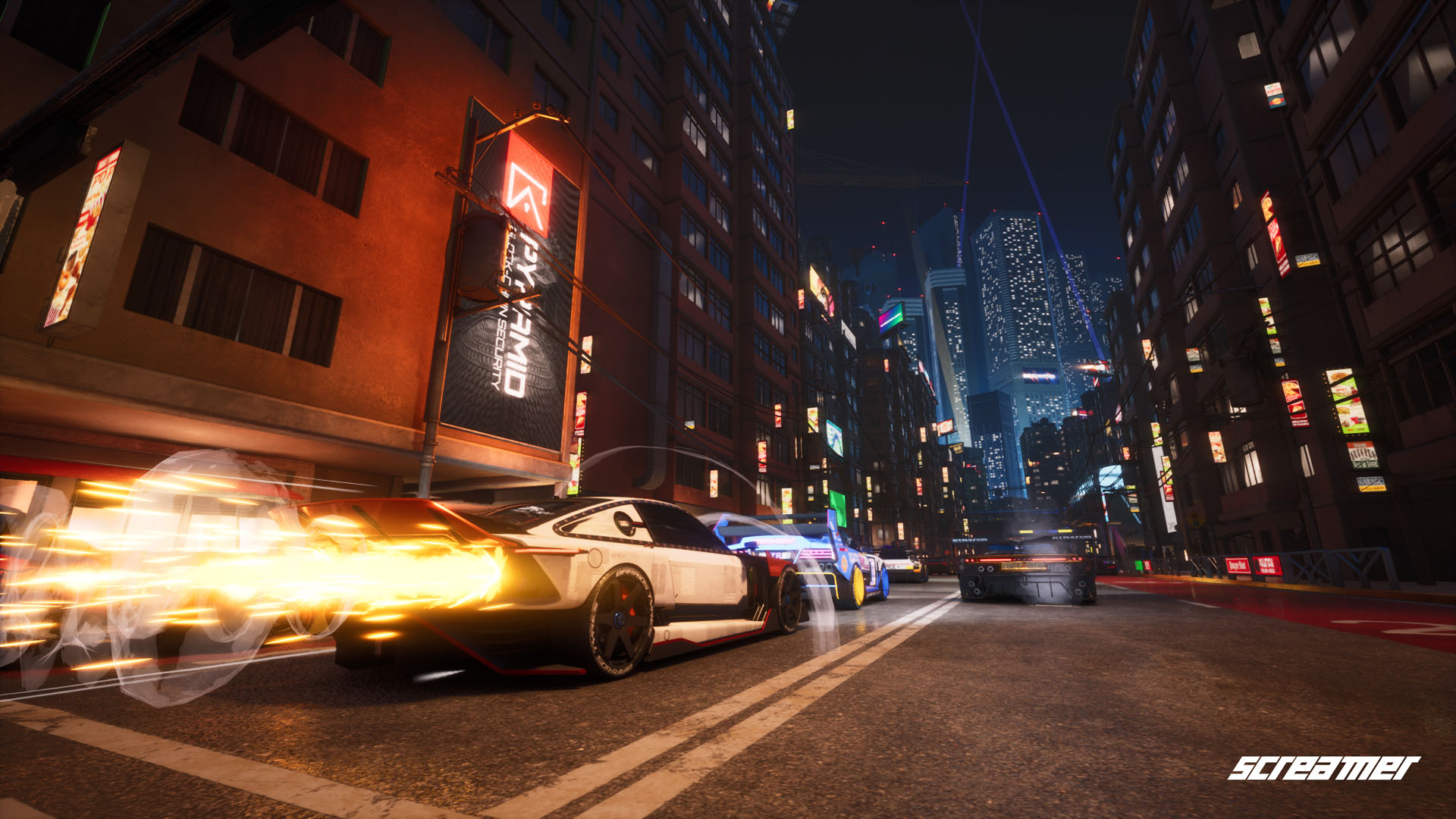
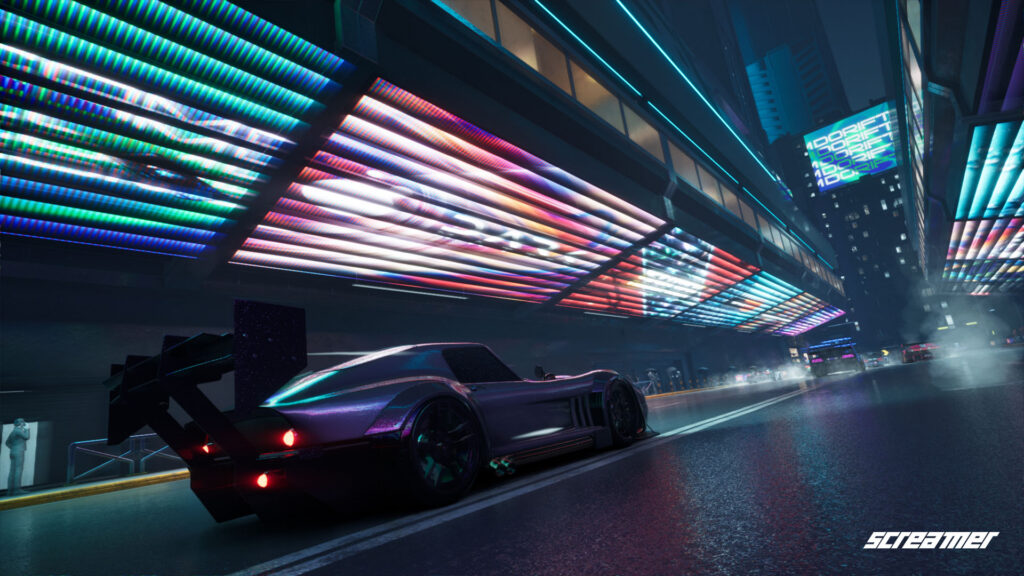
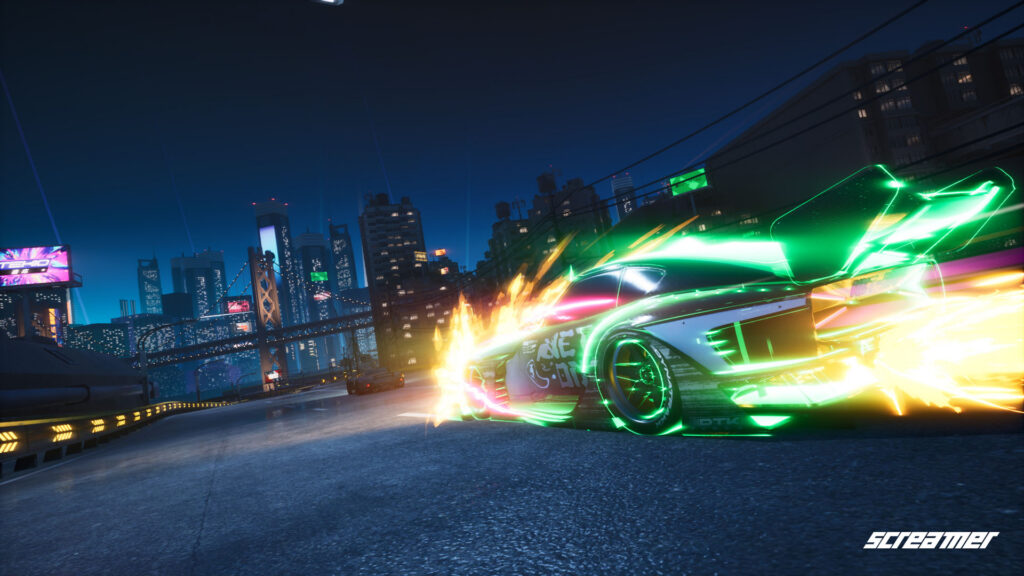
Screamer launched to positive reviews over six months ago, with critics and players praising its unique twin-stick driving, anime aesthetic and fighting-game-inspired mechanics. Developed by Milestone, it was a valiant attempt to revitalise arcade racing, a genre that hasn’t seen mainstream success in recent years.
“Screamer was and still is a very bold game,” its Game Director, Federico Cardini, told Traxion. “Before release, you never know where you’re going to land. Players are the ultimate critics, and so we are glad to see that they enjoyed it.”
Fans particularly connected with Screamer’s anime-style story, which sees a group of street racers seek revenge and discover a mysterious device known as the Echo that can activate supernatural abilities.
“I was most surprised by how people resonated with some characters and the narrative,” Cardini reflected when discussing Screamer’s reception. “Dirk in particular has become a fan favourite. That was unexpected because he is not a good person.”
Its anime style didn’t resonate with everyone, however. “We also got feedback from people who didn’t vibe with it. But that’s to be expected: a bit of friction is inevitable when you’re trying to do something new.”
Risk versus reward
With the last entry released over 25 years ago, relaunching the dormant IP was always going to be risky, with most new players unfamiliar with the franchise.
“You know it’s a risk when you release something like this,” said Cardini. “But that was the point. With Screamer, we wanted to push the boundaries of what arcade racing can do. We think we hit the mark with that.”
As for whether the risk paid off financially, Milestone wouldn’t divulge any sales figures, but Screamer was “very popular on PC,” according to Cardini, bolstered by the platform’s rabid anime fanbase. “It’s also been very popular on PlayStation,” he added.
Conversely, player numbers reported by SteamDB suggest that Screamer was overlooked by the wider racing game community despite its reception, with a modest all-time player count of 724 on Steam. This month, its peak dropped to just 54 at the time of writing.
However, Cardini feels that a racing game’s success shouldn’t be harshly judged by its player numbers.
“There is a tendency to compare player numbers among titles and immediately declare the death of a game, which sometimes leads to bad word of mouth,” he said. “But racing games have never been at the forefront of the genres. They have a very specific player base, which is not massive, but good enough.”
“You have your unique titles like the Gran Turismos or the Forzas, which draw in millions of players. But we can’t compare every racing game to Forza and Gran Turismo. That’s a fool’s errand.
“If we did that, we would declare death for every other game. I see people’s opinions, but sometimes I feel they are too extreme on the racing side.”
Some argue that racing games have faded in popularity compared to the days when a Need for Speed entry sold millions of copies during the Fast & Furious era. Cardini believes this is a misconception, as the genre still has a passionate and loyal fanbase.
“I don’t think the community has shrunk,” he said. “It’s more that players of all types in gaming have increased. I don’t think racing has become less relevant.”
The timing of Screamer’s March release wasn’t ideal either, with the arcade racer launching during a “peculiar year for gaming.”
“It’s a difficult year to gauge success because GTA is around the corner and that’s been the main discussion point for the entirety of the year,” he said.
Grand Theft Auto VI’s delay from May to November this year may have seemed like a blessing for Milestone, but it caused a ripple effect as developers scrambled to release titles before Rockstar’s behemoth.
Consequently, Screamer had to compete with a raft of high-profile releases pushed forward to the first half of the year, from 007 First Light and Pragmata to, most notably, Forza Horizon 6. “It’s probably the biggest year in gaming ever,” Cardini reflected.
New single-stick controls were inspired by Street Fighter 6
Since Screamer launched in March, post-launch updates have added new accessibility options to attract new players. In response to feedback, characters were rebalanced, steering wheel support was added and story dialogue that “dragged on a bit too much” was altered.
Crucially, the complex mechanics are now explained outside of the story campaign in newly added tutorials.
“Not everyone wants to play the story,” said Cardini. “Some people just want to race for a bit, get to grips with the mechanics and then go to the story. Tutorials available outside of that was a very important patch for us.”
In a surprise move, the most recent update added an alternative, more conventional control option that maps steering and drifting to a single stick – despite the twin-stick scheme being one of Screamer’s defining features.
“Some people had strong opinions on the twin stick [controls], especially in the first few hours,” Cardini explained. With multiple mechanics to juggle, skipping the story and jumping straight into arcade mode with no guidance was overwhelming for some.
Milestone was once again inspired by fighting games when implementing the single-stick controls. “Street Fighter 6 features two different control schemes,” Cardini explains.
“They preserved the classic controls with the motion inputs, like your quarter circles. Then they have done a new ‘Modern’ control mode, which lets you do special moves with a single button. There are benefits and drawbacks to both.
“Modern is not a substitute of classic,” he insists. Screamer was designed to be played using twin sticks, which Cardini feels still “offers the best experience.”
“You have a level of control and interaction with the Ecosystem that [the] single stick doesn’t quite reach. You can’t control the two things independently, so you have less control over how the car moves.
“That said, if you’re at the beginning of the game and don’t want to be overwhelmed with all the mechanics, it’s a nice accessibility option where people can use a more familiar control scheme at the beginning, get to grips with it and then maybe switch to twin stick.”
When designing the twin-stick controls, Milestone was worried it would “put some people off because it’s completely different from what they expect.”
“We were on the fence,” Cardini recalled, as the team debated adding a single-stick option from the start. However, Milestone feared this would make players think that using the twin sticks isn’t “the actual way to play.”
Ultimately, player feedback convinced the developer to add a single-stick option, but this wasn’t a case of simply adding it to the existing game. Instead, accommodating the new control scheme required rebalancing the characters and adjusting every car’s steering and drift angles.
Ironically, some players figured out how to remap the steering and drifting to one stick as a workaround before the update, but Cardini feels the result was “janky” with the existing physics.
“Some cars wouldn’t feel good to drive when using the single stick [before the update] because they immediately drift and you feel like they are too frantic to drive,” he said.
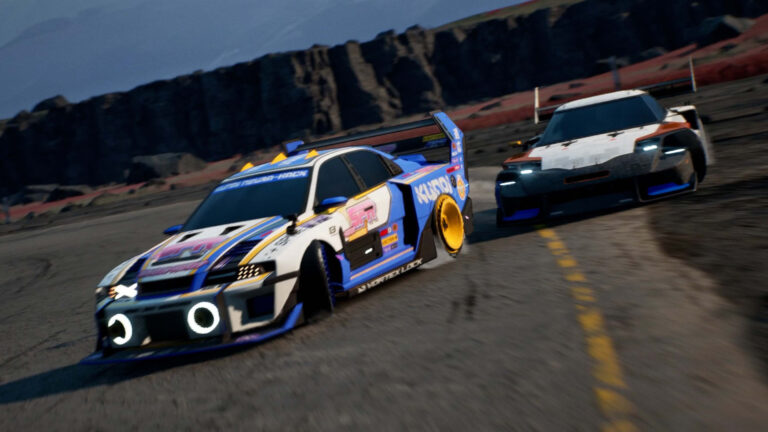
“A car like Gabriel’s is very slow and momentum-based in a drift. You feel like you can’t control it because you start steering, but then it takes forever to get into the drift. We had to tweak all of this.”
“We don’t want to deliver a game that relies on other mechanics to bring you back in”
As for future updates, Cardini admits to having the “usual developer mindset of a game is never finished,” but reaffirms that “Screamer is not a FOMO or Battle Pass-based game.”
“It’s a complete experience,” he said. “That was always the plan. We don’t want to deliver a game that relies on other mechanics to bring you back in.”
Milestone seemingly isn’t finished with Screamer yet, though. Cardini teases that players can look forward to a mystery “surprise” in the future, but couldn’t share more details. “We are working on something that is taking up most of our attention,” he teased. “Stay tuned: we have a surprise coming.”





Discussion