

Sometimes, an indie racing game strikes a chord.
Using limited resources, but free from corporate shackles, they can occasionally invent new, absorbing gameplay loops, taking a sideways look at the genre with mesmeric results.
Think Inertial Drift or New Star GP.
We’re here to say that Super Woden Rally Edge is another one of these formidable gems…
What’s in the box?
There have been three prior games in this series: 2020’s Woden GP, 2021’s Super Woden GP and 2023’s Super Woden GP 2, all by Spanish solo creator ViJuDa.
While the main games in the series featured an isometric perspective and encompassed various types of both road-going and motorsport vehicles, this is a dedicated rally-focused spin-off.
Unsurprisingly, given its name.
But what is a surprise is how, despite its narrowed approach, Rally Edge retains a varied sense of fun combined with automotive nerdism of the highest order.
In many ways, laser focusing on one type (with some subtle variations) of racing has formed a tighter experience, one that will appeal to both rally newcomers and long-time gearheads.
Before we dive into the main single-player career, let’s discuss what’s on offer.
This is available on the 15th January 2026 for PC via Steam for £10.99 or €12.79. And rejoice, this is a solid, complete video game from day one with no early access. We expect console versions to hopefully follow later, much like its siblings.
As it is a rally game, your primary rival is the stopwatch against times set by computer-controlled rivals, as opposed to circuit racing like prior instalments. For that modest sum, there are eight countries (each with multiple stages), over 80 cars, the aforementioned career, online leaderboards, a checkpoint-based arcade mode, plus local split-screen multiplayer for up to four.
Oh, and a sense of care and fun that are far more important than a feature list, frame rate counts or loading times.
As it happens, though, it can do those too. Waiting times pre-stage are swift and even on modest PC hardware, performance is smooth. While it is not Steam Deck verified, yet, it works well on Valve’s handheld too in our testing – its diminutive stature befitting a portable device.
It delivers
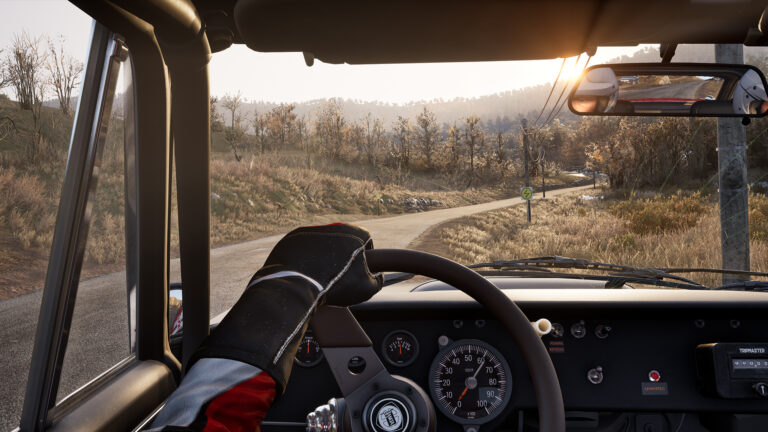
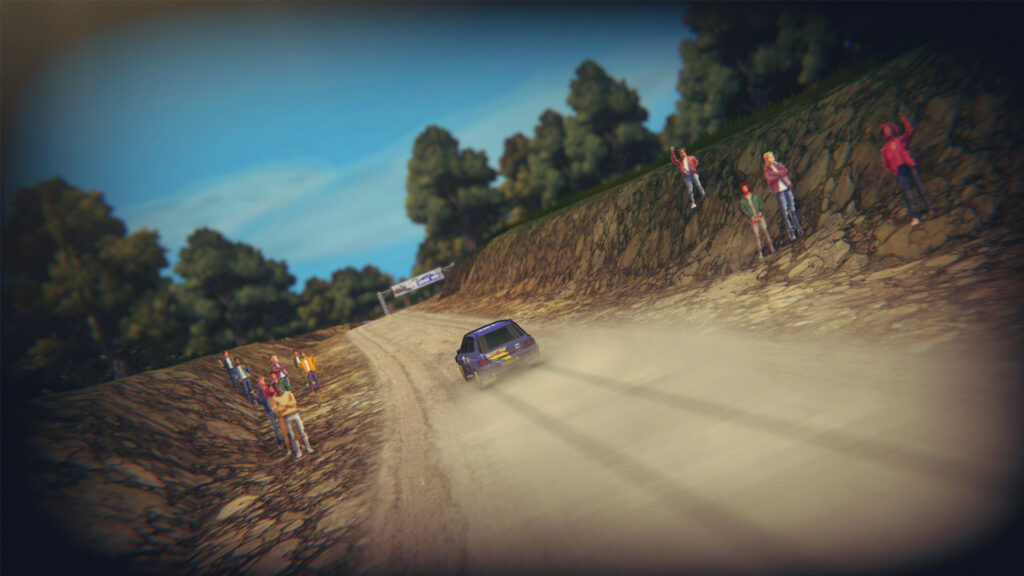
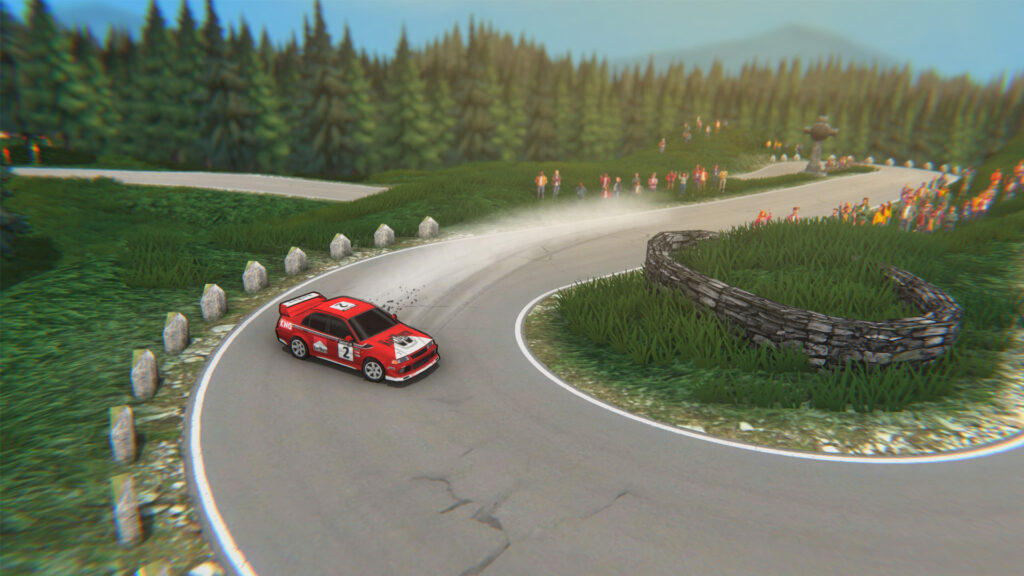
The first thing you will notice is the switch from top-down to chase camera perspective, compared to its counterparts. You can go low and close, much like many other contemporary rivals, such as the upcoming iRacing Arcade, for example.
However, unlike that title, however, you can have the camera high up. As you’re trying to read point-to-point roads that you’ll likely never have seen before, the extra milliseconds this viewpoint may afford you make it our resolute favourite.
This is paired with benign vehicle handling. This is an accessible title for gamepad players, and proudly so – although not without a challenge, it’s just that cornering performance isn’t the main test.
That doesn’t mean the dynamics are without nuance, though. Front-wheel-drive beginner cars scrabble for grip at the front, but a quick dab of the handbrake or a well-timed throttle lift will see the rear slide in a satisfyingly linear fashion. Understeer is boring, so they are setup to four-wheel drift more often than not.
Rear-wheel-drive cars move more from their hind legs, although perhaps not in an immediately obvious RWD fashion. Again, controlled slews as opposed to Driftborthers’ style drifts.
The all-wheel-drive rally cars are the real beasts. Here, the sense of speed is impressive. By the time you make it to the Lancia Delta Integrale, erm sorry, the ‘Aalia DaVinci’’, it’s quite the system shock just how rapidly the scenery flies by. Or, you know, how quickly you find the nearest tree…
The key is timing, and that improves with practice, but perfectly sliding from one corner to another, or finally making it around a hairpin without hitting the barriers, is fist-pumpingly satisfying.
It’s with the quicker cars where the challenge really ramps up, as you also navigate ever-intrecate stages.
The right amount of career
Through the titular ‘Rally Edge’ career mode, you will be treated to more complex route design, with Japanese routes featuring undulating, downhill sections that narrow, Spanish stages with sinewy hairpin switchbacks or the treacherous French Alps with deathly drops and inclement conditions.
The joy being the considered pace at which the game reveals the roads, meaning even in the latter sections of the campaign, you are still discovering new stretches of gravel and asphalt. There’s even a Pikes Peak-inspired USA hillclimb to discover near the end.
Beautifully paced to keep you interested, so too are the cars.
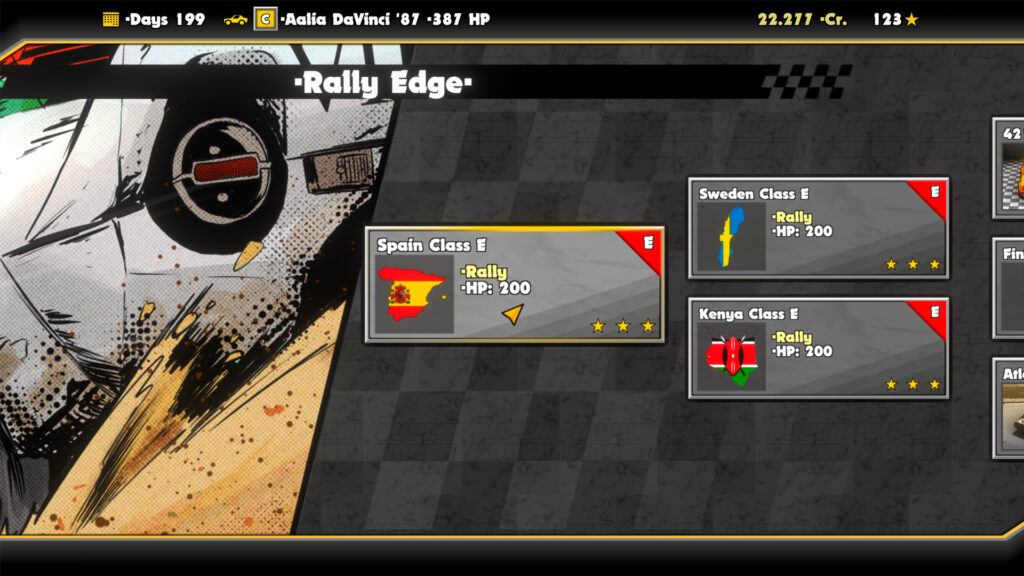
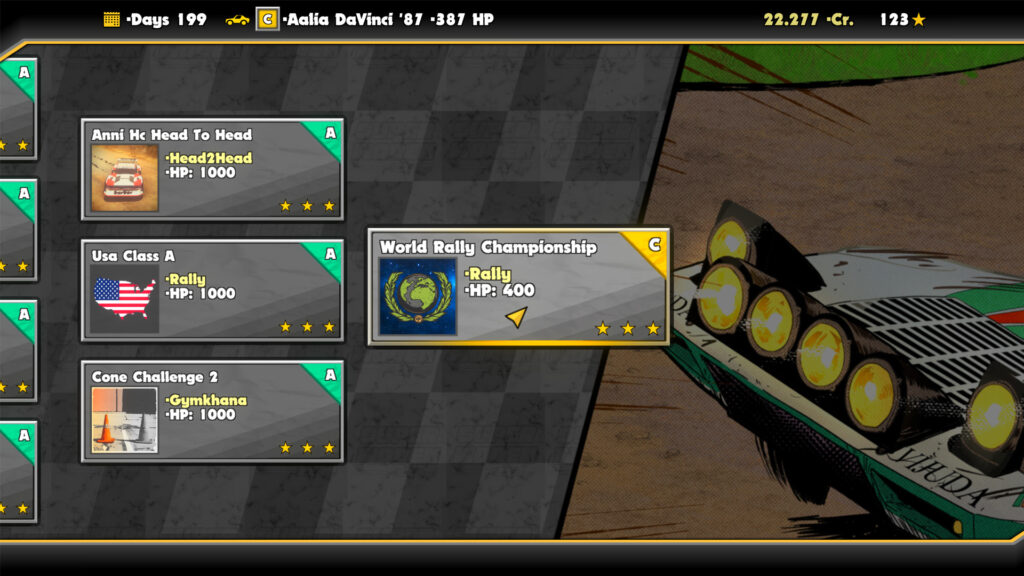
There are five vehicle classes, E to A, determining horsepower for the determinedly retro lineup. These categories help define which events to enter next. The career structure is relatively simple, a path left to right, with events for Class E vehicles on the left and reaching the quicker cars by the end (although the final World Championship is an exception, using the Class C cars).
Finish in the top three and earn a star, finish second and earn two and win for three – further events are locked by the total number of stars you earn.
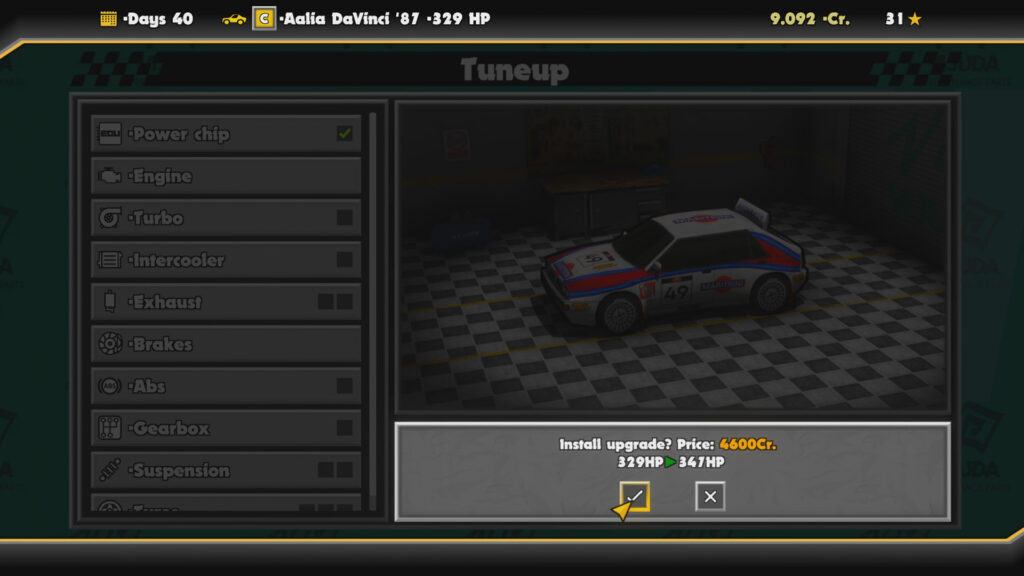
On top of which is cash, earned through strong results and spent on new cars and upgrades. These range from the basic car wash and oil change, to new brakes, ABS systems, tyres, suspension or turbos. Lots of giant turbos.
In fact, in later events, not only will you be wrestling with the higher speeds on narrow tracks, but also single-player rivals that up their game. Spending cash on vehicle upgrades after the first set of events is essential. Mercifully, you can also sell models to earn greater cash to either tune or purchase the next required car.
Prize cars are gifted too, for winning championship events or beating a rival during the Head 2 Head events, for instance.
It all combines to form a delicious progression system, like a grad bag of crisps – you just know the whole thing will be eaten.
You want to continue to see new stages, to buy quicker cars and take on tougher rivals. And, as we’ve already alluded to with the Head 2 Head events, there is more than just straight rally stages.
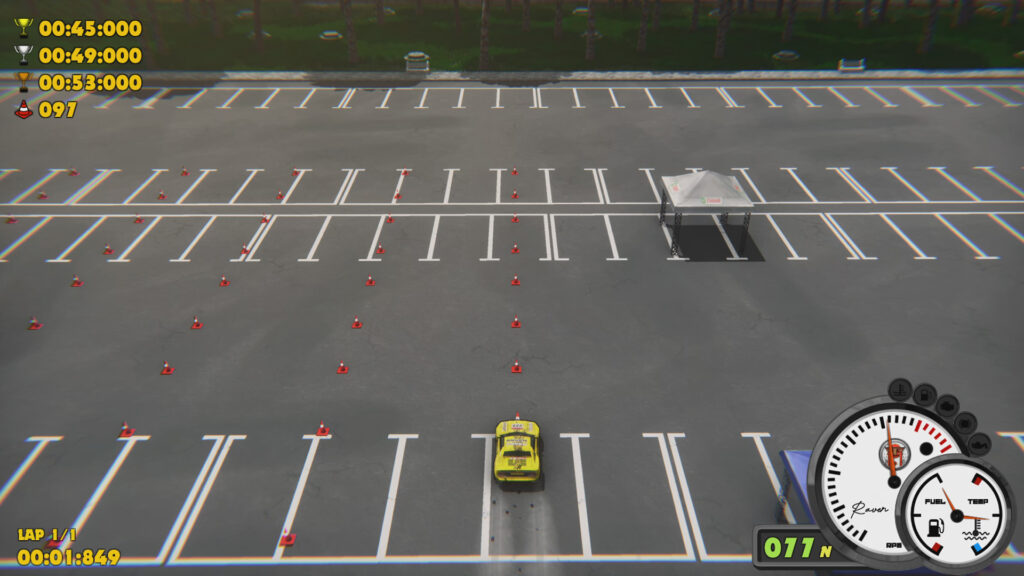
Some of our favourites are the sporadic Gymkhana-style tests, where completing a short course, including jumps, or knocking down cones, within a tight time limit is the aim. A slight shame there’s no extra points for driving panache or accuracy, too, as in real-world challenges of a similar ilk.
Still, as everything you do is not just against AI-controlled rivals, but also online leaderboards, we found ourselves retrying the Gymkhana events again and again, trying to beat our colleagues. During Head2Head races, too, a neat mini-online leaderboard pops up mid-race to check your progress against friends just to urge you on.
If it all sounds like an ideal mix of rewarding progression systems, variety and a refined driving experience, then you’d be right. It is.
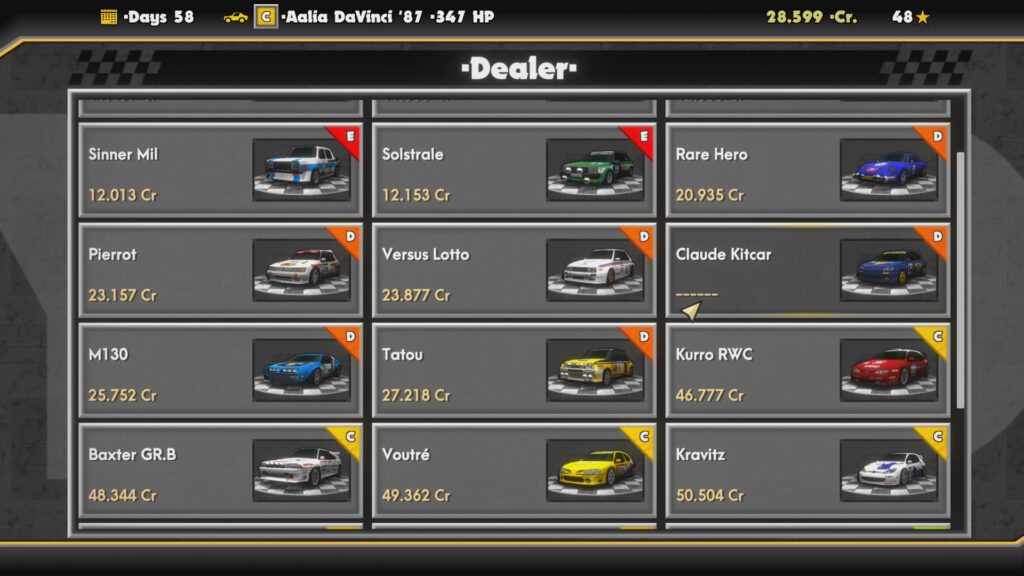
We should also touch up on the vehicle list, which is completely fictional. Of course they are, officer. Honest.
The, let’s say, inspiration is clear for rally fans, such as the De Castro Zabibi MK2, which resembles a Seat Ibiza F2 car, just in our opinion, naturally. Or… the Raven Teramoto. Some might say it’s a facsimile of a Suzuki Escudo Pikes Peak competitor. Maybe.
From the car shapes to the ‘made-up’ sponsors, you can just tell that the creator has a deep knowledge of the real-world sport. This attention to detail is apparent across all aspects of the game, such as the photo mode, custom soundtrack, stage-side furniture or the co-driver voice-over for setting a leaderboard world record.
Still, Super Woden Rally Edge isn’t perfect; that would be ridiculous… wouldn’t it?
But… nothing, actually
Right. Ahem. Well… We noted that some of the pacenotes could be re-timed or altered for directions with a little more precision. Maybe there could be a few more call-types, like “left entry chicane” instead of ‘medium left, medium right’. Just an idea. We also noticed that the on-screen split times can seem a little falsified at times, possibly.
The cars are rated by horsepower, but it would be nice to have a rating for overall performance, too, like a PP-style score. But, really, that’s about it.
Minor quibbles aside, as smaller rally games go, this is a triumph. Two members of the Traxion team devoured the moreish seven-to-nine-hour career mode as quickly as possible for this review, and there’s still the urge to go back and collect more stars and cars.
It’s even more staggering to think that this tightly packaged bundle of joy has been created by one person.
ViJuDa, we salute you.



Chat with the Community
Sign Up To CommentIt's completely Free
Uhhh, how did you manage to NOT mention Art of Rally?
This isn’t an art of rally review.
Also, you don’t have to mention art of rally in every game review. LOL.
No, its an art of rally ripoff.
Also, if someone clones a game you are supposed to mention it. Its called journalism. LMAO.
Whut – it looks different, had vastly different handling and sounds and has a completely different strucutre.
In your mind a ‘AOR rip-off’ seems to be any indie rally game. Joker.
AOR is brilliant, SWre is brilliant – both are quite different., both can coexist without annoying you