
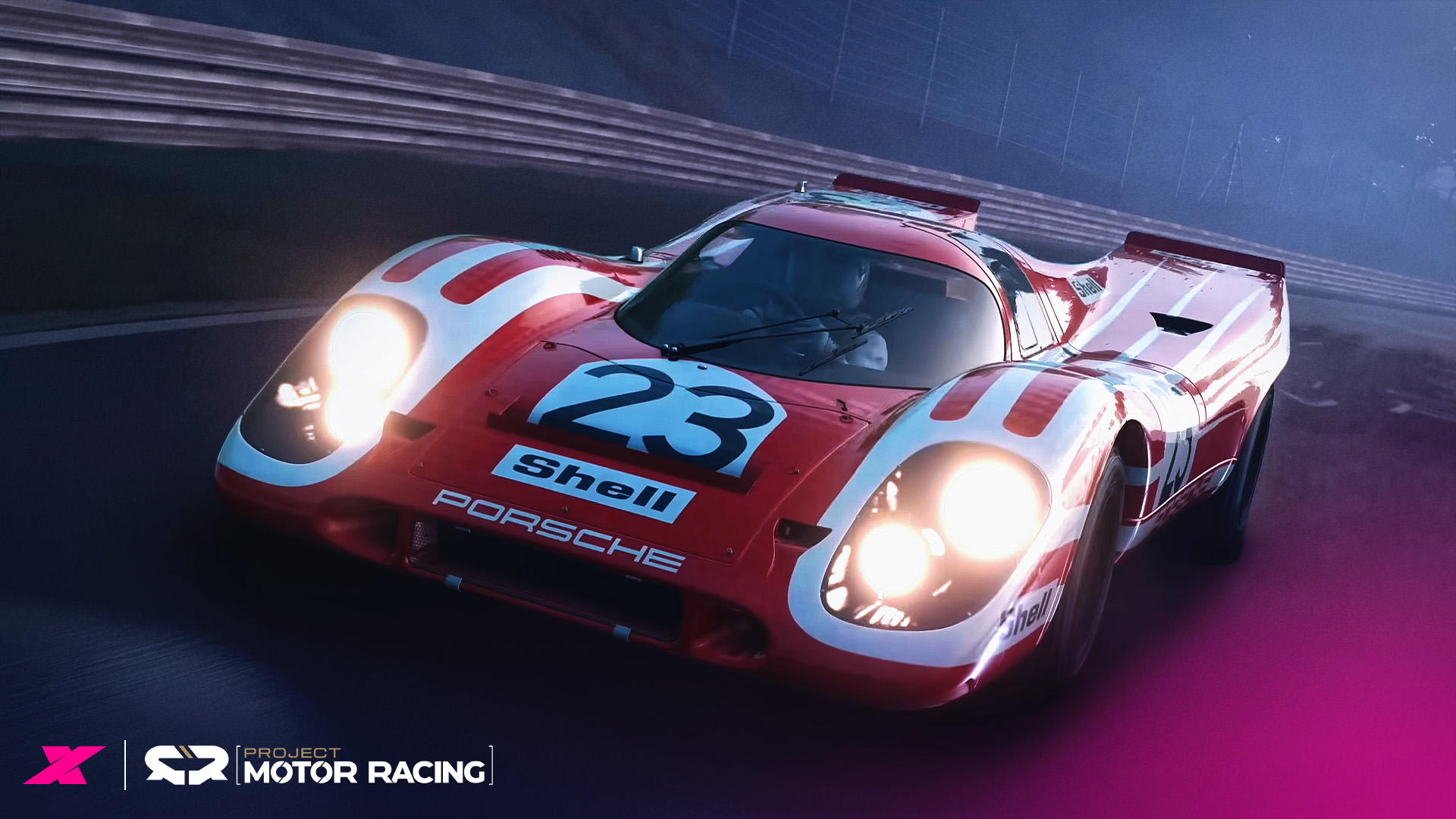
There are times when Project Motor Racing hits its stride. Take the 1989 Roush Mercury Cougar XR-7 around the Nürburgring. This is the game at its very best.
Sadly, however, these moments where everything gels are few and far between.
Welcome to Traxion’s full review…
Words by Thomas Harrison-Lord, Ross McGregor and John Munro.
Neccessary Context
This game can trace its lineage back to the former Project CARS series, Need for Speed: Shift and the ‘00s GTR simulations.
In fact, it was originally titled ‘GTR Revival’, then ‘GT Revival’ in homage, before finally settling on ‘Project Motor Racing’.
This is created by the Straight4 Studios development team, born from the ashes of the cancelled Project CARS 4. The vehicle dynamics and physics systems here are said to be all-new, paired with the graphics technology seen in Farming Simulator. This is the first time it has been used for anything other than straw bales and JCBs.
On PC, PlayStation 5 and Xbox Series X|S, PMR is billed as a serious driving simulation, up against the likes of Assetto Corsa Competizione or Le Mans Ultimate.
It has around 70 motorsport machines, a roster that mixes contemporary beasts from endurance racing – think LMDh, GT3 and GT4 – mixed with the alluring nostalgia of past masters.
Tracks, too, follow a similar path. There are ubiquitous staples such as Spa Francorchamps, Daytona and the Nürburgring, but then making up the 18-strong list are Lexington and Derby.
No, you may not have heard of those names, but don’t be deceived by the fictional titles – they are laser-scanned venues heavily ‘inspired by’ the real world. Once you hit the circuit, the Aldi phantom brand names become less of an issue.
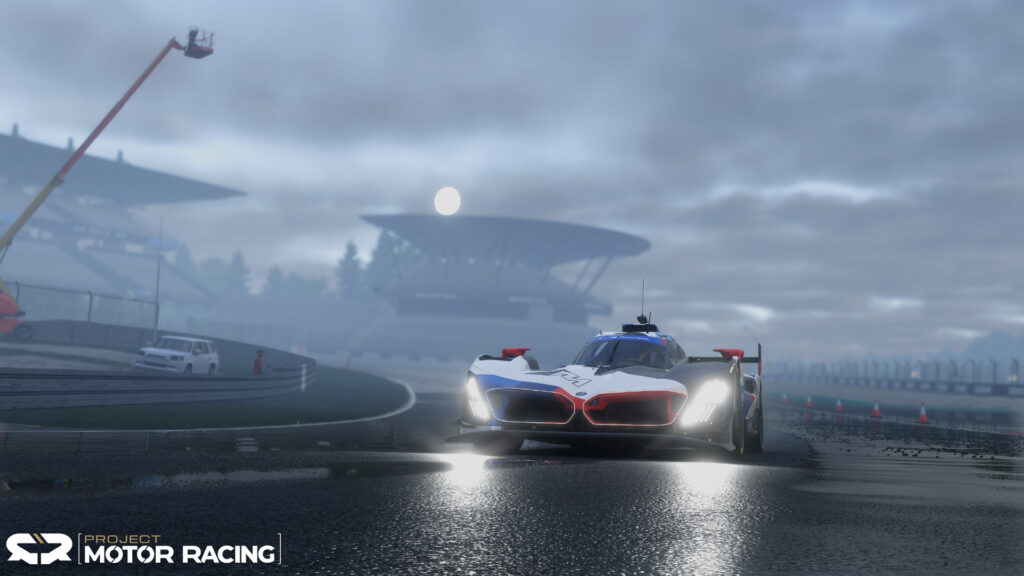
Vehicle dynamics
With a force-feedback steering wheel, it’s a mixed bag: while some cars feel benign and malleable, others are skittish and unintuitive.
For example, the N-GT class, which is filled with powerful sports cars like the Mosler MT900R and Marcos Mantara LM600, feels suitably brutal, requiring a light right foot and circumspection in braking zones (they emit a rather beefy exhaust note, too, especially compared to some of the other, more artificial-sounding cars).
The MX-5 Cup is similarly compliant, which feels appropriate given the car’s entry-level positioning.
Aside from these examples, many possess odd handling characteristics. The Porsche 911 GT3 Cup has to be driven with pinpoint precision: breathe on the brake pedal and the pads clamp to the rotors like magnets.
It’s an odd sensation at first; during a ranked online race, we found ourselves driving oh-so-carefully just to keep the car on track. Handling is twitchy: minimal throttle in the lower gears causes the rears to spin up, with the subsequent correction exaggerated by the game’s eager force feedback.
For most cars, the Nürburgring Grand Prix layout’s first corner off-camber braking zone proved to be particularly problematic in terms of brake lock-ups, but since you can’t feel flat spots through your steering wheel, some of the jeopardy has been removed (flat spots have been implemented visually and thermally to an extent, however).
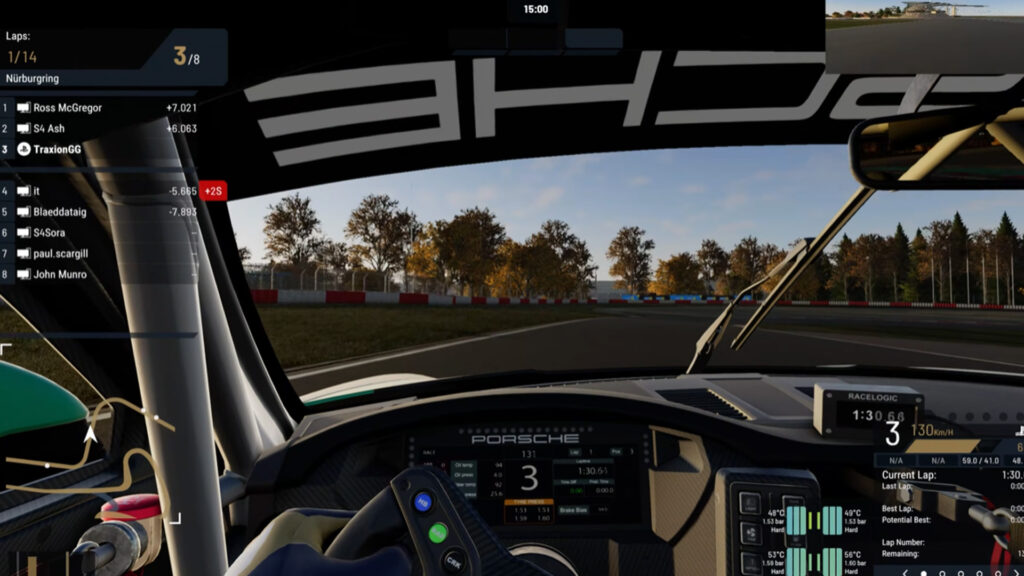
Likewise, Mosport’s heavily contoured Moss section also provides a tricky challenge. This section flummoxes every car we’ve driven so far; tentatively braking and turning results in either a lock-up or off-throttle oversteer. It’s almost as though there’s a lack of pliancy in the suspension, like the car’s dampers and springs can’t compute elevation changes and your driving inputs concurrently.
We must single out LMDhs, which are a huge challenge to drive in any modern sim. Here, they have a bizarrely obtrusive traction control system. Turn a corner and floor the throttle, and it will cut in aggressively, preventing any wheelspin. There are no TC Cut or TC Slip Angle settings, so the implementation lacks nuance.
The hybrid simulation is similarly flawed, as the electrical power doesn’t appear to provide any efficiency gains.
Most of the game’s GT3 and Hypercars understeer using default setups, and downshifting too early can cause the rear-end to step out of line, even when auto-blip and downshift protection functions are enabled.
It makes PMR’s GT3 and Hypercar driving experience a strange one, but we’ve found that tuning the differential settings can improve their handling.
Changing the diff preload to 250, power ramp angle to 90 and coast ramp angle to 75, you get a much more stable platform to work with, both on and off throttle.
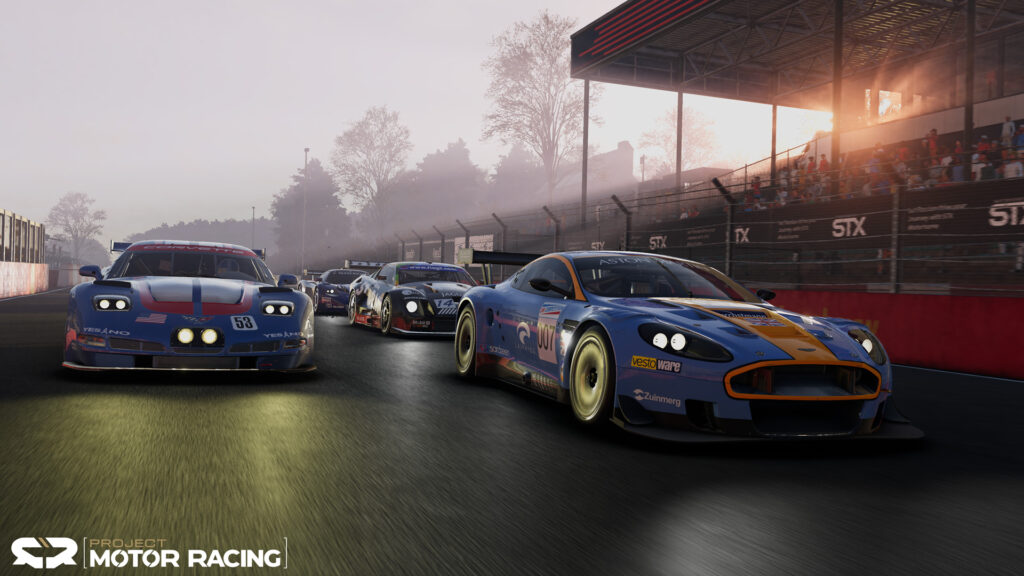
In the end, short-shifting and smoothing out our inputs were the best ways to achieve quick and safe lap times, but the general knife-edge balance between under and oversteer was more difficult to manage than in other sims.
There are positives, however. PMR’s force feedback is both reactive and informative on our test wheel bases, providing a decent amount of detail to your hands. A satisfying jolt accompanies every gear change, while kerb strikes are communicated clearly.
The FFB is not perfect by any means, and is only as good as the physics of the cars it covers, with possibly our main gripe being the amount of oscillation we had to dial out, with additional in-game smoothing required to smooth off some of its rough edges. An overall gain reduction also helped.
We then need to mention how it feels on a gamepad… While some cars like the GT3s are almost palatable, for others, woeful would be an understatement. Despite some sliders that allow for saturation and sensitivity adjustments, driving an LMDh feels like playing a middle-of-the-road mobile game with touch controls, and is a noticeable backwards step compared to earlier preview builds.
Visuals
If the car handling is a mixed bag, then the graphics are just plain poor.
Not since Dwayne Johnson’s mix of scorpion, human and CGI in The Mummy Returns has graphical performance been such a letdown.
With one notable exception: the best grass in sim racing. You can spot individual elements, and your car’s tyres realistically flatten them when you drive across.
But, as much as the grass impresses, and the rain can too, the general lack of visual fidelity disappoints.
It’s a lazy trope to say ‘this looks like a PS3 game’ or ‘it’s the same as a mobile title’, but here, in replays, this looks like… a PS3 game or mobile title.
Which is odd, as when you’re on the car selection screen, the models look jewel-like in their detail, and even on track, the interiors seem to be accurate.

Yet, Sebring’s colour palette can look washed out, the day-to-night transition hurts your eyes, trackside detail pops up and rival cars’ wheels are blurred unnaturally. And that’s on some reasonably beefy PCs. On a standard PS5, the lack of detail is borderline unacceptable at times.
It stings when the game can also run a smoothly as sandpaper. In our testing on PC, upping the rival AI-controlled car count to beyond 15 can result in significant slowdowns and chugging. It’s funny because on console, there’s a limit of 15 AI rivals, which is upped to 31 on PC, but due to the performance hit, it may as well be 15 there, too.
We experienced brief pauses and stutters – which we’re told is being worked on – and frequent frame dips. With more glitches than The Matrix, trying to secure a stable 60 frames per second on PC is an interminable quest of fiddling around in various settings.
Mercifully, things are more stable on a PS5, just about maintaining a consistent 60 fps most of the time, although rain is less compliant. Console players may have to drive something less aesthetically appealing than a blank sheet of paper, but at least they aren’t spending more time in menus than on track.
Career, AI and Damage
Aha, you might say, ‘I’ve been looking for a sim-like single-player career to delve into’, something absent in a great deal of existing sim-like games.
Well, there is one, and theoretically, it has a refreshing angle.
If you follow real-world GT or sports car motorsport, most of those drivers are paying for their seat. So Project Motor Racing takes that market force and turns it into a game.
You can begin with one of three cash allowances, $100,000 being the most modest quantity, allowing you to purchase either a classic Porsche 911 or the omnipresent Mazda MX-5. At the highest end, $2,000,000 allows you to start in the big leagues.
The championships you enter depend on the car you buy. Pick the MX-5, and you start off with a handful of one-make championships. Go all out on a Peugeot 9X8 and you can enter the LMDh World Championship from the off.
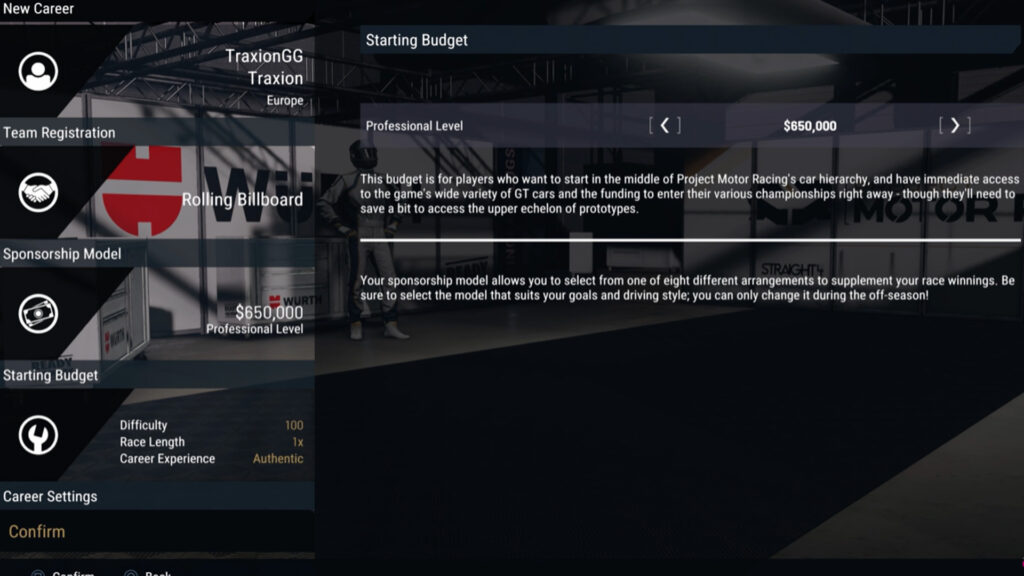
More interesting, perhaps, is the gamified nature of the payouts. There are eight sponsorship models. One will pay a bonus if you win races, for instance, while another will pay if you set the quickest lap time.
Anyway, the point is: pay entry fees, finish races, earn cash, buy more cars, sell some others, unlock more events through owning an expanded garage. If you run out of money, your career will be over. However, it simply isn’t enjoyable presently thanks to several factors.
Vehicle damage levels are a pivotal component, as you must spend cash on car repairs between each event. Therefore, car contact needs to be naturalistic and accurate. It’s anything but.
If you rub against the rear three-quarters of a rival, the front of your car can pass through its rear. The collision detection from some angles is less accurate than a water pistol with a blocked nozzle.
A mild side-by-side rub, or a tap on the rear end, can damage your roof, somehow. Also, while we are here, why do impacts sound like someone hitting a wooden spoon against a kitchen counter?
The frustration is compounded by your AI-controlled rivals’ inability to sense your presence just before the end of a braking zone.
Simply, if you make a move down their inside, fully alongside and controlled, they will still turn in. Hard. There goes your clean race…
Elsewhere, you can have some great battles down straights, coming out of corners and in terms of pace, they can provide an authentic challenge. A victory will be hard fought, and a top-five is a challenging target from a lower grid spot.
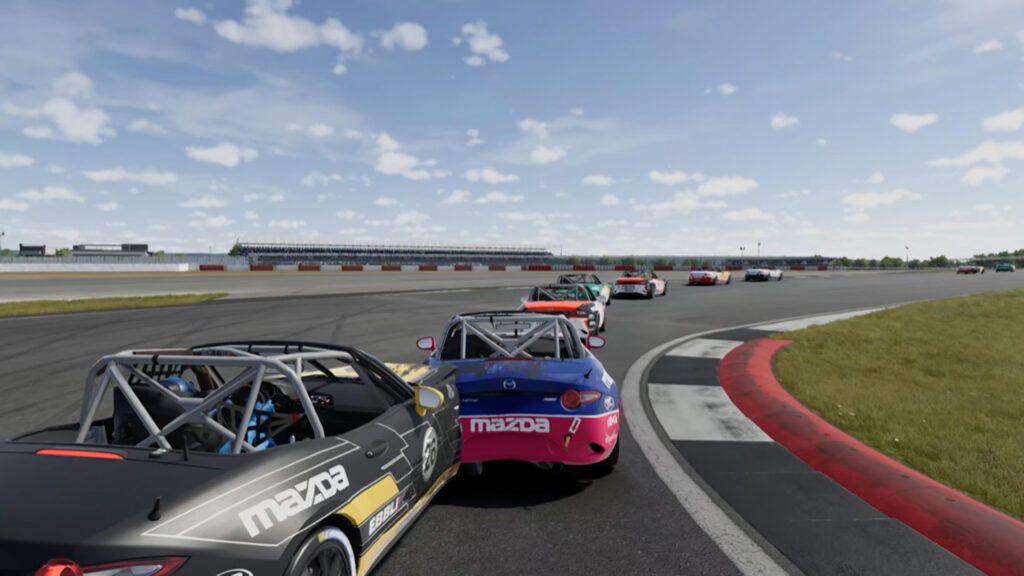
Then again, on the opening race lap, they congregate a little too closely, and then around high-speed corners, they are too timid, while being speed demons around tight turns.
The experience is topped off by a track limits system that is both punitive and contradictory. Make a mistake and run into the gravel on the outside of Zolder’s opening corner, it’s a two-second track limit strike. This is nonsensical. You’re not cutting the track there; you are mid-crash.
If you cut an entire chicane, it’s also a two-second track cut penalty. It hands out a reprimand for spinning into gravel traps, and then doesn’t provide enough of a penalty when deliberately cutting the course.
There is some user interface oddness here, too, such as not being able to see how many races or laps are in a championship before committing. Some of the sponsorship models talk of car ‘prestige’ levels, but what that means simply isn’t explained. We assume this correlates to price, but the game should explain.
So you can end up three laps from the end of a hard-fought 12-lap race, when the AI unwittingly turns in on you, causing you damage, and then, compounding issues, receiving an unjust track limit penalty.
Neat idea, frustrating implementation.
Multiplayer and Mods
If the career is a let-down, multiplayer seems more promising.
Once you’ve completed a brief licence test race to provide you with an initial rating, there’s a list of ranked races for multiple car classes. Competing in these will further add to your driver rating, per car category, and also provide points to your championship standing.
We completed a session before review, and it seems relatively stable, albeit before the events are flooded with players and with the odd floating car. Outside of ranked, if you’d like to open a lobby for friends to race in, this is quick, easy and cross-platform – the latter feature is smooth in testing.
It’s perhaps worth noting that, unlike some other sim titles, even for the ranked element, this doesn’t use dedicated servers for the on-track action. The official line is:
“Our hybrid approach uses a low-latency p2p connection for all the vehicle data between players to ensure that we can give as accurate a representation as possible of other players’ positions while also using a dedicated server to handle anti-cheat and state management in a secure environment,” Straight 4 Studios representative.
Another area that deserves a mention is modding, or user-generated content. Once the game is released, it is open to modders, and there are some available as test cases already.
This could be licensed cars (such as this Praga Bohema), single-player race events and liveries, plus pro-driver car setups and tracks are expected soon.
On PC outside of this system, you are free to create and share whatever you wish via third-party services. But the main draw here is cross-platform, including console, approved mod content that can be browsed and downloaded from within the game’s menus.
This could be a significant feature that helps carry the title long after its initial launch. Time will tell.
To conclude…
The Traxion team is bitterly disappointed as it stands. A multi-platform sim racing game, with an approved modding system, single-player career mode and ranked multiplayer is what the industry needs right now.
Given that the vehicle dynamics are built from scratch and they are combined with a graphics engine out of its comfort zone, there is tremendous scope to polish, refine, tweak and upgrade.
Emphatically, though, PMR isn’t a complete package yet. It needs a gravel-gargling Sean Dyche-style turnaround.
Once time and several updates have passed, we’ll happily revisit Project Motor Racing. But at launch, we can only give it a lowly score.
Score: 5/10
“Ambitious, but crudely disappointing”
Version 1.5 will be released after this review with the following fixes, which are welcome, but don’t touch the majority of our main critiques.


Chat with the Community
Sign Up To CommentIt's completely Free